
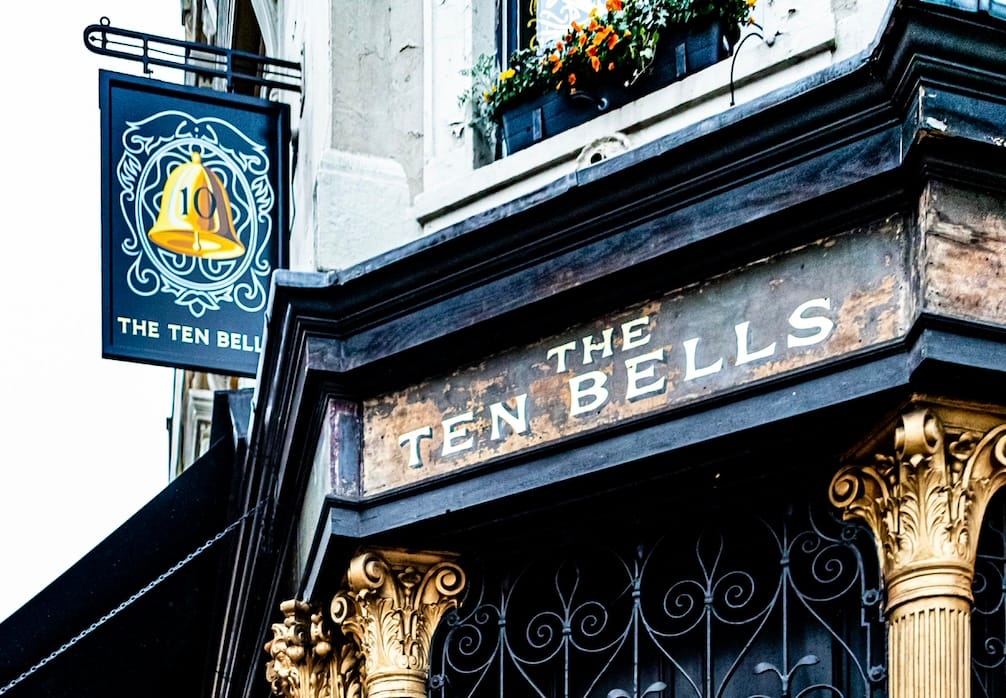
Standing on the corner of Commercial Street and Fournier Street in Spitalfields, the Ten Bells pub has poured pints for over 270 years. But it’s not the Victorian tiles or the craft beer selection that draws visitors from around the world. It is the pub’s long association with the Whitechapel murders, especially Mary Jane Kelly and Annie Chapman, that draws much of that attention — although the surviving evidence is uneven.
Heritage note: Historic England’s official Grade II listing dates the present Ten Bells building to the mid-nineteenth century and records its coloured tiled interior.
If you’re planning a Jack the Ripper tour in London, understanding the significance of this Grade II listed building adds useful historical context to your experience.
A Brief History of the Ten Bells
The Ten Bells predates the Ripper by more than a century. Records show a pub on this spot since at least 1752, though it was originally called the Eight Bells after the chimes in the neighbouring Christ Church, Spitalfields — the striking Nicholas Hawksmoor-designed church that still looms over the pub today.
When the church installed a new set of ten bells in 1788, the pub followed suit with its name. The original building was demolished in 1851 when Commercial Street was cut through the area, and the pub was rebuilt just a few metres from its original location. This is the building you can visit today.
What makes the Ten Bells architecturally significant is its remarkably preserved Victorian interior. Floor-to-ceiling ceramic tiles in striking blue and white patterns cover two walls, and a magnificent painted tile mural titled Spitalfields in ye Olden Time – Visiting a Weaver’s Shop dominates the north wall. Created by W.B. Simpson & Sons in the late 19th century, it depicts the area’s Huguenot silk-weaving heritage.
The Jack the Ripper Connection
The Ten Bells’ place in the history of the Whitechapel murders comes from its later associations with the case. The Ten Bells has long been associated with two of the five canonical victims, but the strength of the surviving evidence differs from claim to claim.
Mary Jane Kelly
The most significant connection is to Mary Jane Kelly, the Ripper’s fifth and final canonical victim. Some later accounts place Kelly on the pavement outside the Ten Bells, but that detail is not firmly established by the surviving official evidence.
A later press account attributed to Elizabeth Foster placed her with Mary Kelly at the Ten Bells shortly before Kelly’s death, but this should be treated as a reported recollection rather than a complete record of Kelly’s final evening. Kelly was found the following morning in her room at 13 Miller’s Court, Dorset Street.
A retired market porter named Dennis Barrett, interviewed years later by author Tom Cullen, remembered Kelly from his childhood: “She had her pitch outside the Ten Bells Pub in Commercial Street, and woe to any woman who tried to poach her territory. Such a woman was likely to have her hair pulled out in fistfuls.”
Standing outside the Ten Bells places you in the same small part of Spitalfields described in later accounts of Kelly’s life, but those accounts do not establish her exact movements.
Annie Chapman
The second canonical victim linked to the Ten Bells is Annie Chapman. Contemporary newspaper reports stated she was seen drinking alone in “a pub near Spitalfields Market” at around 5am on the morning of 8th September 1888, just hours before her body was discovered in the backyard of 29 Hanbury Street.
Because the Ten Bells stands opposite Spitalfields Market, later writers have proposed it as the unnamed pub in the report. The identification is plausible but unproven; Hanbury Street is a short walk away.
Did the Ripper Himself Drink Here?
There is no reliable evidence that the unidentified killer drank at the Ten Bells. Its location close to lodging houses, markets and streets connected with the case explains why the idea became part of later Ripper folklore, but proximity is not proof.
The responsible answer is therefore simple: he may have entered the pub, as countless local people did, but the surviving evidence cannot tell us that he did.
When the Pub Was Called “Jack the Ripper”
In 1976, a landlord hoping to capitalise on the pub’s macabre history renamed it “The Jack the Ripper.” The interior was redecorated with display cases containing memorabilia and information about the Whitechapel murders, and the venue leaned heavily into its dark tourism appeal.
The name change proved controversial. A sustained campaign by the Reclaim the Night movement argued that naming a pub after a murderer of women was inappropriate and glorified violence against women. The campaign succeeded, and in 1988 — exactly 100 years after the murders — the brewery restored the original Ten Bells name.
When the Ripper-themed décor and disco lighting were stripped away during the 1980s, the pub’s stunning Victorian interior emerged intact underneath, having been preserved by the garish overlay.
The Ten Bells in Popular Culture
The pub’s Ripper connections have made it a fixture in books, films, and television about the case.
Most notably, the Ten Bells features in Alan Moore and Eddie Campbell’s acclaimed graphic novel From Hell (1999) and its 2001 film adaptation starring Johnny Depp. In the film, Depp’s Inspector Abberline shares a drink with Mary Kelly (played by Heather Graham) inside the pub. However, the building shown on screen was an on-set recreation rather than the real Ten Bells.
In a quirky footnote, celebrity chef Jamie Oliver featured the pub in his series Jamie’s Great Britain in 2011. His great-great-grandfather was apparently a landlord of the Ten Bells during the 1880s — meaning Oliver’s ancestor may have served drinks to the Ripper’s victims.
Visiting the Ten Bells Today
The Ten Bells remains a fully functioning pub and is well worth a visit, whether you’re interested in the Ripper history or simply appreciate a characterful East End boozer.
Address: 84 Commercial Street, London E1 6LY
Nearest stations: Liverpool Street (5 minutes walk), Aldgate East
Opening hours: Check the official Ten Bells website for current hours before visiting.
Map: Open the Ten Bells at 84 Commercial Street in Google Maps.
Open in Google Maps ↗
What to look for:
- The original Victorian ceramic wall tiles in blue and white patterns
- The painted tile mural Spitalfields in ye Olden Time depicting 18th century Spitalfields
- The companion mural Spitalfields in Modern Times (added in 2010) featuring local artists Gilbert & George
- The faded Truman’s Beers signage on the exterior
- The view across to Christ Church Spitalfields
Food, drink, entry and payment policies can change. Check the official Ten Bells website for current opening times and visitor information before travelling.
Experience the Full Story on a Jack the Ripper Tour
The Ten Bells is just one landmark in the story of Jack the Ripper. To truly understand the context of the murders — the poverty and overcrowding of Victorian Whitechapel, the gas-lit alleyways where the crimes occurred, and the panic that gripped London during the Autumn of Terror — join us on our Jack the Ripper walking tour.
Our expert guides will take you through the murder sites, share the evidence, and let you draw your own conclusions about history’s most infamous unsolved mystery. Many of our evening tours end at or near the Ten Bells, giving you time to reflect on the women’s lives and the history you have just explored.
See the wider story on foot
Visit the surviving streets, compare documented evidence with later folklore and understand how the Ten Bells fits into Victorian Whitechapel.
Explore our Jack the Ripper tour →
Frequently Asked Questions
Is the Ten Bells pub still open?
Yes. The Ten Bells remains a working pub at 84 Commercial Street in Spitalfields. Opening times and house policies can change, so check the official Ten Bells website before visiting.
Was the Ten Bells open in 1888?
Yes. A pub with the Ten Bells name was operating when the Whitechapel murders took place. Historic England dates the present Grade II-listed building to the mid-nineteenth century, so the building visitors see today predates 1888.
Did Jack the Ripper’s victims drink at the Ten Bells?
Later accounts associate Mary Jane Kelly with the pub, while an unnamed pub near Spitalfields Market was mentioned in reporting about Annie Chapman. The Ten Bells identification is plausible in some accounts but is not conclusively established for either woman.
Did Jack the Ripper drink at the Ten Bells?
There is no reliable surviving evidence that the unidentified killer drank there. The claim belongs to later folklore rather than a proven part of the case.
Can you visit the Ten Bells?
Yes. It is a public house rather than a museum. Visitors can see its historic tiled interior, but should treat it as a working local business and check current opening information before travelling.
Planning your visit? The Ten Bells gets busy on weekends, particularly with the nearby Spitalfields Market drawing crowds on Sundays. For a more atmospheric experience, visit on a weekday evening when the candlelit interior and quieter atmosphere better evoke the pub’s Victorian past.