"It felt like a murder mystery experience" one of thousands of five-star reviews ★★★★★

Category: Jack The Ripper Tours

Jack The Ripper Tours

  • Planning a Jack the Ripper School Trip: A Teacher’s Guide to Whitechapel

    Planning a Jack the Ripper School Trip: A Teacher’s Guide to Whitechapel

    A Jack the Ripper school trip can do far more than revisit an unsolved murder case. Planned responsibly, a walk through Whitechapel lets students examine Victorian poverty, migration, housing, policing, journalism and the limits of historical evidence in the district where those issues can be studied together.

    This guide is for teachers considering a Whitechapel history trip, particularly for Key Stage 3, GCSE and A-Level groups. It explains the curriculum links, what to ask a tour provider, how to prepare students and how to keep the focus on evidence and the people who lived in the East End—not on sensationalism.

    Last reviewed: 5 October 2026. Teachers should check the current exam specification and request the provider’s current route, risk assessment and content policy before booking.

    Why Visit Whitechapel Rather Than Study It Only in the Classroom?

    Whitechapel is unusually well suited to place-based learning. Students can move between streets associated with lodging houses, markets, immigrant communities, police jurisdictions and the 1888 investigation within a relatively compact area. Much of the relevant built environment has disappeared or been redeveloped, so surviving street relationships are most useful when read alongside historic maps, plans, photographs and records.

    A walking tour also makes historical distance visible. Students must compare what survives with what has disappeared, ask whether a modern location can represent an 1888 environment, and distinguish a documented address from an approximate historic position. Those are not merely tour-guide questions; they are questions about how historians reconstruct the past.

    The strongest learning objective: use the murders as a case study, not the whole story. The educational value lies in what the investigation reveals about Victorian Whitechapel, policing, inequality, the press and historical evidence.

    Pearson Edexcel GCSE History

    The clearest curriculum match is Pearson Edexcel’s historic environment study, Whitechapel, c1870–c1900: crime, policing and the inner city. Pearson’s teaching material identifies housing, overcrowding, poverty, migration, lodging houses, H Division, investigative policing, competing police jurisdictions and media coverage of the murders as central areas of study.[1]

    A well-structured visit can therefore turn specification language into place-based enquiry. Students can consider why policing alleys and courts was difficult, how jurisdiction affected the investigation, and why newspaper reporting created additional pressure. The visit is supplementary: it cannot cover the full specification or replace classroom teaching and source work.

    Key Stage 3 and A-Level

    For Key Stage 3, Whitechapel supports broader work on Victorian cities, industrialisation, migration, poverty, public health and social reform. For older students, the same streets can support deeper source evaluation: who created a document, why it was preserved, what it leaves out and how later storytelling changes public memory.

    The National Archives offers a Whitechapel education session for Key Stages 3 and 4 that explores poverty, immigration, women’s lives, housing and the usefulness of historical sources.[2] That makes an archive-to-street sequence especially useful: analyse a source before the trip, test it against the location, then revisit it afterwards.

    What Can Students Learn on a Jack the Ripper School Tour?

    Victorian social conditions

    Overcrowding, insecure housing, casual employment and the role of common lodging houses—without reducing every East End resident to a stereotype.

    Policing before modern forensics

    The work of Metropolitan Police H Division, the separate City of London Police, limited investigative techniques and the difficulties created when the investigation crossed jurisdictions.

    Migration and community

    Whitechapel as a diverse neighbourhood shaped by Irish and Eastern European migration, Jewish communities, work, religion and political tension—including unsupported antisemitic scapegoating during the investigation.

    Newspapers and public fear

    How dramatic reporting, anonymous letters and commercial competition helped turn an unsolved investigation into an enduring legend.

    Source reliability

    The difference between contemporary evidence, later recollection, press invention and modern speculation.

    The victims as people

    The lives, housing, relationships and work of Mary Ann “Polly” Nichols, Annie Chapman, Elizabeth Stride, Catherine Eddowes and Mary Jane Kelly—not only the circumstances of their deaths. “Canonical five” is later historical shorthand, not a formal contemporary police category, and the number attributable to one offender remains uncertain.

    Charles Booth’s poverty maps are particularly useful for comparing place and evidence, but they are not a direct snapshot of the murders in 1888. The interactive LSE map principally presents the 1898–99 survey, created roughly a decade later, and colour-codes streets by the income and social class assigned to their residents. Students should consider both the time gap and the assumptions built into the surveyors’ classifications.[3]

    The case also offers an opportunity to challenge inherited myths. London Museum notes that historians have increasingly focused on the women’s lives and that contemporary and later accounts often labelled all five as prostitutes without adequate evidence.[4] For students, this is a practical lesson in how repetition can harden an assumption into “fact”.

    Is Jack the Ripper an Age-Appropriate School Topic?

    It can be, provided the delivery is restrained and matched to the group. The educational case does not require graphic detail. Teachers should agree boundaries around spoken descriptions, images, violence and sensational speculation with the provider before booking.

    Our school tour is designed mainly for Year 8 to Year 11 groups and can be adapted for A-Level students. Teachers should still share the age range, learning objectives, desired content boundaries and any pastoral considerations in advance. A class studying source reliability needs a different emphasis from a group visiting as part of a general London programme.

    A responsible guide should explain uncertainty openly. “Canonical five” is later historical shorthand, disputed suspects should be identified as theories, and modern streets should not be presented as untouched crime scenes. Students should leave with better questions, not an invented solution to an unsolved case.

    Teacher Planning Checklist

    1. Define one or two learning objectives. Decide whether the priority is policing, the historic environment, source evaluation, Victorian poverty or media history.
    2. Confirm the level of detail. Tell the provider the students’ ages and agree how violence, spoken descriptions and images will be handled.
    3. Request the practical documents. Ask for a current risk assessment, route outline, emergency contact, cancellation terms and accessibility information.
    4. Agree staffing and group arrangements. Confirm the maximum group size, free staff places, guide allocation and how guides communicate with teachers. Apply your school or local-authority requirements for staff-to-student ratios.
    5. Check the route. Whitechapel includes busy roads, cobbles and narrow passages that may create barriers. Discuss mobility, sensory, SEND and medical needs, possible route adaptations and any inaccessible sections before confirming.
    6. Plan movement and emergencies. Agree road-crossing procedures, headcounts, toilets, an emergency regroup point and what happens if transport disruption delays the group.
    7. Plan for London weather. Comfortable shoes and waterproof layers matter more than atmospheric costumes. The tour is an outdoor lesson.
    8. Prepare students for public space. The group will move through working streets used by residents, businesses and other visitors.
    9. Plan a follow-up task. A visit is most valuable when students must use what they observed afterwards.

    Our Jack the Ripper school tour in London runs for approximately 90 minutes. Group sizes and departure times are flexible, with risk assessments, free staff places and group rates available on request. The emphasis can be adapted around your class’s age and learning objectives; teachers should agree the exact route, content boundaries and any possible accessibility adaptations before booking.

    Activities Before, During and After the Visit

    Before the trip

    • Locate Whitechapel, Spitalfields and the City of London on a modern map.
    • Compare the modern map with the Charles Booth poverty map, while noting that the interactive survey principally dates from 1898–99 rather than 1888.
    • Give students one newspaper extract, police document or map and ask what it can—and cannot—prove.
    • Introduce the five women through short biographies rather than beginning with suspect theories. Our guide to the canonical five victims provides a responsible starting point.

    During the trip

    • What features of this street would have made policing difficult in 1888?
    • Which parts of the guide’s account come from contemporary evidence, and which are inference?
    • How has redevelopment changed what historians can observe here?
    • Who produced the sources being discussed, and whose voice is missing?
    • Why did the press find the case so commercially powerful?

    After the trip

    • Create an annotated map connecting locations with specific curriculum themes.
    • Write a judgement on the greatest obstacle facing police in Whitechapel.
    • Compare a sensational newspaper account with a police or inquest source.
    • Audit a modern Jack the Ripper claim: what is its evidence, and how certain should the wording be?
    • Write a short museum label about one victim that restores identity without using graphic crime detail.

    Questions to Ask Any School Tour Provider

    • How do you adapt the tour for different ages and exam specifications?
    • Do you centre the historical environment and the victims, or primarily tell suspect stories?
    • What graphic content, if any, is included?
    • Can you provide a current risk assessment and route plan?
    • How do you manage large groups on narrow pavements?
    • What adjustments are possible for mobility, hearing, sensory or medical needs?
    • Are staff places included, and what is the cancellation policy?
    • What happens in severe weather or major transport disruption?

    Planning a Whitechapel school trip?
    See the full school-group tour details or contact the team with your preferred date, group size, year group and learning objectives. We can then recommend the most appropriate format and provide a quote.

    Jack the Ripper School Trips: Frequently Asked Questions

    Is the tour suitable for GCSE History?

    It can support Pearson Edexcel’s Whitechapel historic-environment study when the route and teaching emphasis are matched to your scheme of work. It is a supplementary learning experience, not coverage of the complete specification or a replacement for classroom teaching. It can also support broader work on Victorian Britain, policing, migration, poverty, journalism and source evaluation.

    What age is the school tour designed for?

    It is primarily designed for Year 8 to Year 11 students and can be adapted for A-Level groups. Teachers should discuss younger groups and any specific sensitivities before booking.

    How long is the school tour?

    The standard school tour lasts approximately 90 minutes. Exact timing and route arrangements should be confirmed for your group.

    Is the content graphic?

    Teachers should agree this explicitly before booking. Ask what spoken descriptions and images are used, and specify the boundaries appropriate for your students. The tour can be framed around the historical environment, policing, evidence, the press and the women’s lives rather than graphic detail.

    Can large school groups be accommodated?

    Group sizes are flexible. Share your student and staff numbers when requesting a quote, and ask how many guides would be assigned, how the group would be managed on narrow pavements and whether any division into smaller groups is recommended.

    Is the Whitechapel route accessible?

    The area includes cobbles, narrow passages and busy pavements that may create barriers for some visitors. Contact the team before booking to discuss individual needs, possible route adaptations and any sections that cannot be made accessible; contacting the operator does not guarantee that every part of the route will be suitable.
    Sources and Further Reading

    1. Pearson Edexcel: Whitechapel historic environment teaching resource
    2. The National Archives: Whitechapel education session
    3. LSE: What were Charles Booth’s poverty maps?
    4. London Museum: Jack the Ripper and Whitechapel in 1888
  • Jack the Ripper Timeline: Key Dates and Events of 1888

    Jack the Ripper Timeline: Key Dates and Events of 1888

    The Jack the Ripper timeline is often reduced to five dates and one unidentified killer. The real sequence is more complicated. The murders took place amid a wider investigation in Whitechapel, while newspapers, anonymous letters, police decisions and public fear shaped the story almost as quickly as events unfolded.

    This chronology follows the key events of 1888, including the five women most commonly grouped as the “canonical five”. It also includes two earlier Whitechapel deaths whose connection remains disputed, and the letters that turned an unknown murderer into the name “Jack the Ripper”. It avoids graphic detail and keeps the victims, evidence and historical uncertainty at the centre of the story.

    What This Timeline Includes

    The official Whitechapel Murders investigation was broader than the five deaths now most closely associated with Jack the Ripper. The surviving Metropolitan Police papers catalogue murders and related correspondence over several years, and historians still disagree about where one offender’s crimes begin and end.

    Important distinction: “The Whitechapel murders” describes a police investigation involving more than five victims. “The canonical five” is a later historical label for Mary Ann Nichols, Annie Chapman, Elizabeth Stride, Catherine Eddowes and Mary Jane Kelly—the five women most commonly believed to have been killed by the same person.

    For a closer look at the women’s lives and addresses, read our guide to the Jack the Ripper victims in Victorian Whitechapel. The chronology below focuses on what happened, when it happened and what can—and cannot—be concluded from the surviving record.

    Before the Canonical Five

    Two deaths earlier in 1888 are essential context. Both were investigated as part of the wider Whitechapel series, but neither can be confidently assigned to the same killer responsible for the canonical five.

    Emma Elizabeth Smith Disputed connection

    Emma Elizabeth Smith was attacked in Whitechapel in the early hours of 3 April and died in hospital the following day. She reportedly described being assaulted by several men. That evidence makes her case very different from the later canonical murders, although her death became part of the same police file.

    Martha Tabram Disputed connection

    Martha Tabram was found dead on a landing in George Yard Buildings, near Whitechapel High Street. Her death occurred only weeks before the canonical series began. Some researchers consider her a possible victim of the same offender; others point to important differences in the attack. The evidence does not settle the question.

    These cases show why a responsible Jack the Ripper timeline must distinguish between the official investigation and later theories. Similar location and timing are not proof of a single offender.

    The Canonical Five Timeline

    Mary Ann “Polly” Nichols

    Mary Ann Nichols was found in Buck’s Row, now Durward Street, in the early hours of 31 August. Her death is generally treated as the beginning of the canonical series. The location lay close to Whitechapel Road and within a short walk of lodging houses where many people without secure accommodation tried to find a bed each night.

    The case immediately drew police attention, but it had not yet produced the name “Jack the Ripper”. At this stage investigators were responding to a local murder, not to the public legend that would soon surround the crimes.

    Annie Chapman

    Annie Chapman was found in the backyard of 29 Hanbury Street in Spitalfields. The second canonical murder, just eight days after Nichols’s death, transformed the investigation. Similarities between the cases strengthened the belief that one person might be responsible.

    The original house and yard no longer survive. Our guide to the Jack the Ripper murder sites today shows how Hanbury Street and the other locations fit into modern London.

    September changes everything: After Chapman’s death, extra police were deployed, detectives interviewed residents and lodging-house occupants, and public anxiety intensified. The investigation unfolded across overlapping Metropolitan Police and City of London Police jurisdictions.

    The “Dear Boss” Letter Reaches the Central News Agency

    A letter dated 25 September and signed “Jack the Ripper” reached the Central News Agency on 27 September. It was later passed to the police. Whether the murderer wrote it has never been established, and many historians believe it was a journalistic invention or public hoax.

    Its importance is cultural rather than evidential: the signature gave the unknown killer the name that newspapers and the public would remember. Our article on the Dear Boss letter explains how the name entered the case.

    The “Double Event”: Elizabeth Stride and Catherine Eddowes

    Elizabeth Stride was found in Dutfield’s Yard off Berner Street, now Henriques Street, shortly before 1am. Less than an hour later, Catherine Eddowes was found in Mitre Square inside the City of London.

    The two deaths became known as the “double event”. Stride’s inclusion among the canonical five remains more debated than the others because the circumstances differed and her attacker may have been interrupted. Eddowes’s death, however, strongly resembled the established pattern. The second location also brought the City of London Police directly into the investigation.

    The “Saucy Jacky” Postcard

    A postcard received by the Central News Agency referred to the previous night’s “double event” and repeated the Jack the Ripper signature. As with the Dear Boss letter, its authorship is unproved. The speed with which it appeared helped bind the murders, the letters and the invented persona together in the public imagination.

    The “From Hell” Letter Authenticity disputed

    George Lusk of the Whitechapel Vigilance Committee received a package containing a letter beginning “From hell” and part of a human kidney. The handwriting and tone differed from the Central News letters, but no reliable evidence proves that it came from the murderer. It remains one of the case’s most disturbing and contested objects.

    Mary Jane Kelly

    Mary Jane Kelly was killed in the room she rented at 13 Miller’s Court, reached from Dorset Street in Spitalfields. Unlike the other canonical murders, this one happened indoors. Kelly is generally considered the fifth and final canonical victim.

    Her death came more than five weeks after the double event. It produced renewed police activity and enormous press attention, but no arrest. Miller’s Court and Dorset Street have since disappeared beneath later redevelopment.

    The Letters and the Name “Jack the Ripper”

    Hundreds of letters reached police, newspapers and public figures during the investigation. Most were obvious hoaxes. The surviving correspondence matters because it shows how quickly the case became a media phenomenon, but it should not be treated as a reliable diary written by the killer.

    • Dear Boss: introduced the Jack the Ripper signature.
    • Saucy Jacky: referred to the double event soon after it happened.
    • From Hell: accompanied a grisly package but used different language and handwriting.
    • Hundreds of other messages: ranged from threats and confessions to jokes, publicity stunts and malicious hoaxes.

    The National Archives preserves examples of this correspondence and explicitly identifies at least one surviving “Jack the Ripper” letter as a hoax. That is a useful warning against building a confident narrative from unsigned or pseudonymous documents.

    What Happened After November 1888?

    The canonical timeline ends with Mary Jane Kelly, but the police investigation did not. Other deaths in Whitechapel were examined for possible connections, and suspects continued to be discussed. No one was charged with the canonical murders.

    The Metropolitan Police file catalogued by The National Archives covers the Whitechapel murders and related correspondence beyond 1888. That longer paper trail helps explain why modern suspect lists can become misleading: later memoranda, recollections and theories are not the same thing as evidence gathered at the time.

    For the leading historical theories, see our guide to the most famous Jack the Ripper suspects. The absence of a definitive answer is also explored in why Jack the Ripper was never caught.

    Why the Timeline Still Matters

    Placing the events in order cuts through several myths. The famous name did not exist when the first canonical victims died. The five murders were not evenly spaced. Two happened within the same hour, while more than five weeks separated the double event from Mary Jane Kelly’s death. The investigation also involved different police jurisdictions, a rapidly expanding press and a flood of unreliable correspondence.

    The timeline also puts the geography into perspective. These events unfolded within a compact but socially complex part of East London. Whitechapel and Spitalfields contained markets, workshops, lodging houses, religious institutions, pubs and wealthy streets within short walking distances. Read what Whitechapel was really like in 1888 for the wider setting.

    Explore the chronology on the streets where it happened.
    Our Jack the Ripper walking tour in London connects the surviving locations with the evidence, police investigation and lives of the women—without treating speculation as fact.

    Jack the Ripper Timeline: Frequently Asked Questions

    When did the Jack the Ripper murders begin?

    The canonical series is generally considered to begin with the murder of Mary Ann Nichols on 31 August 1888. Earlier Whitechapel deaths, particularly those of Emma Elizabeth Smith and Martha Tabram, have sometimes been linked to the same offender, but their inclusion remains disputed.

    How long did the Jack the Ripper murders last?

    The five canonical murders occurred over ten weeks, from 31 August to 9 November 1888. The wider Whitechapel Murders investigation covered additional deaths and continued well beyond that period.

    What was the Jack the Ripper “double event”?

    The double event refers to the murders of Elizabeth Stride and Catherine Eddowes during the early hours of 30 September 1888. Their bodies were found at different locations less than an hour apart.

    When was the name “Jack the Ripper” first used?

    The name became public through the Dear Boss letter, dated 25 September 1888 and received by the Central News Agency two days later. There is no proof that the killer wrote it.

    Who was the last canonical victim?

    Mary Jane Kelly, killed on 9 November 1888 at Miller’s Court, is generally identified as the fifth and final canonical victim.

    Sources and Further Reading

  • Jack the Ripper Murder Sites Today: Map & Locations

    Jack the Ripper Murder Sites Today: Map & Locations

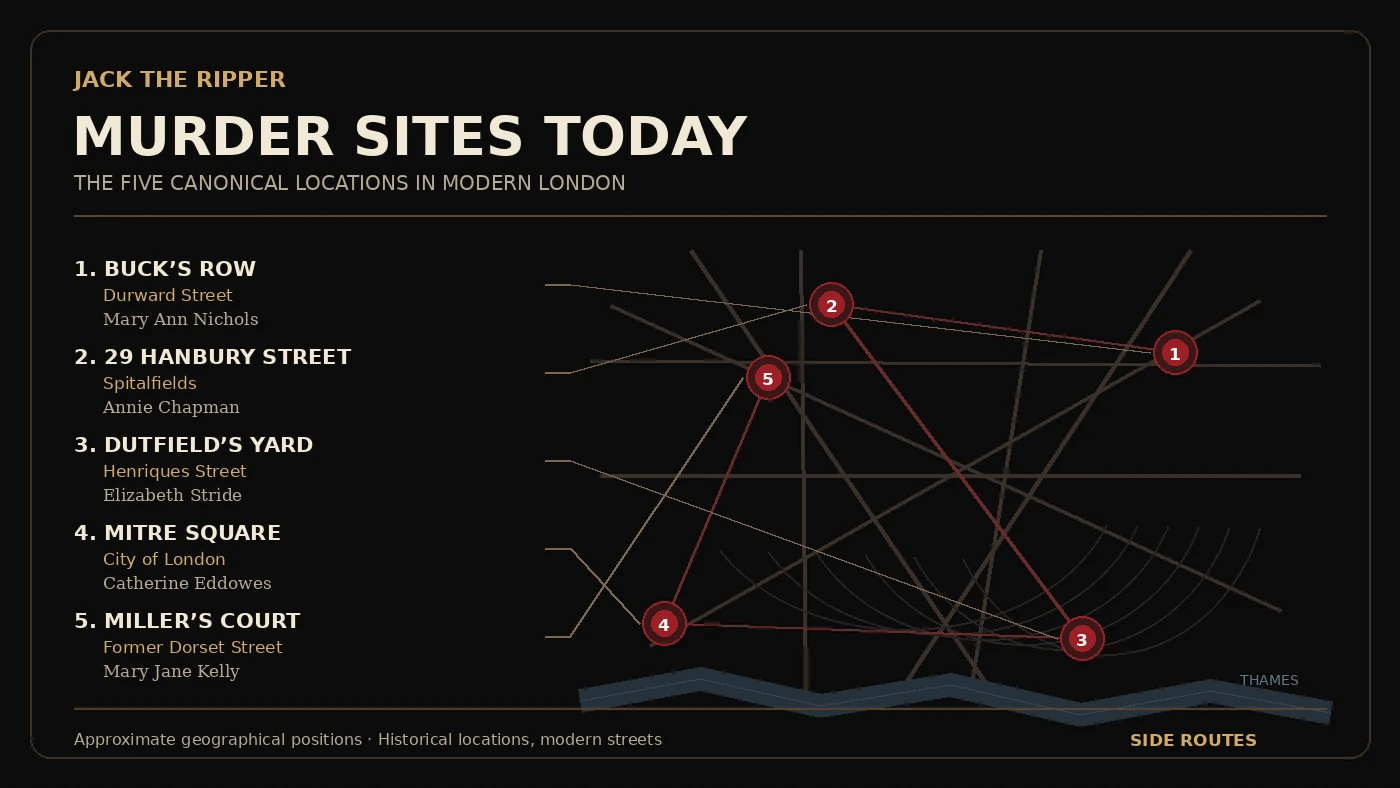
    The Jack the Ripper murder sites are closer together than most visitors expect. The five locations most widely associated with the same killer sit across Whitechapel, Spitalfields and the eastern edge of the City of London. Streets have been renamed, buildings have disappeared and whole blocks have been rebuilt, but the geography of the case can still be traced today.

    This guide maps the five canonical murder sites, explains what each place is called now and shows what remains in modern London. It focuses on the women and the historical landscape rather than graphic detail. Where an original building or yard has vanished, the position shown is necessarily approximate.

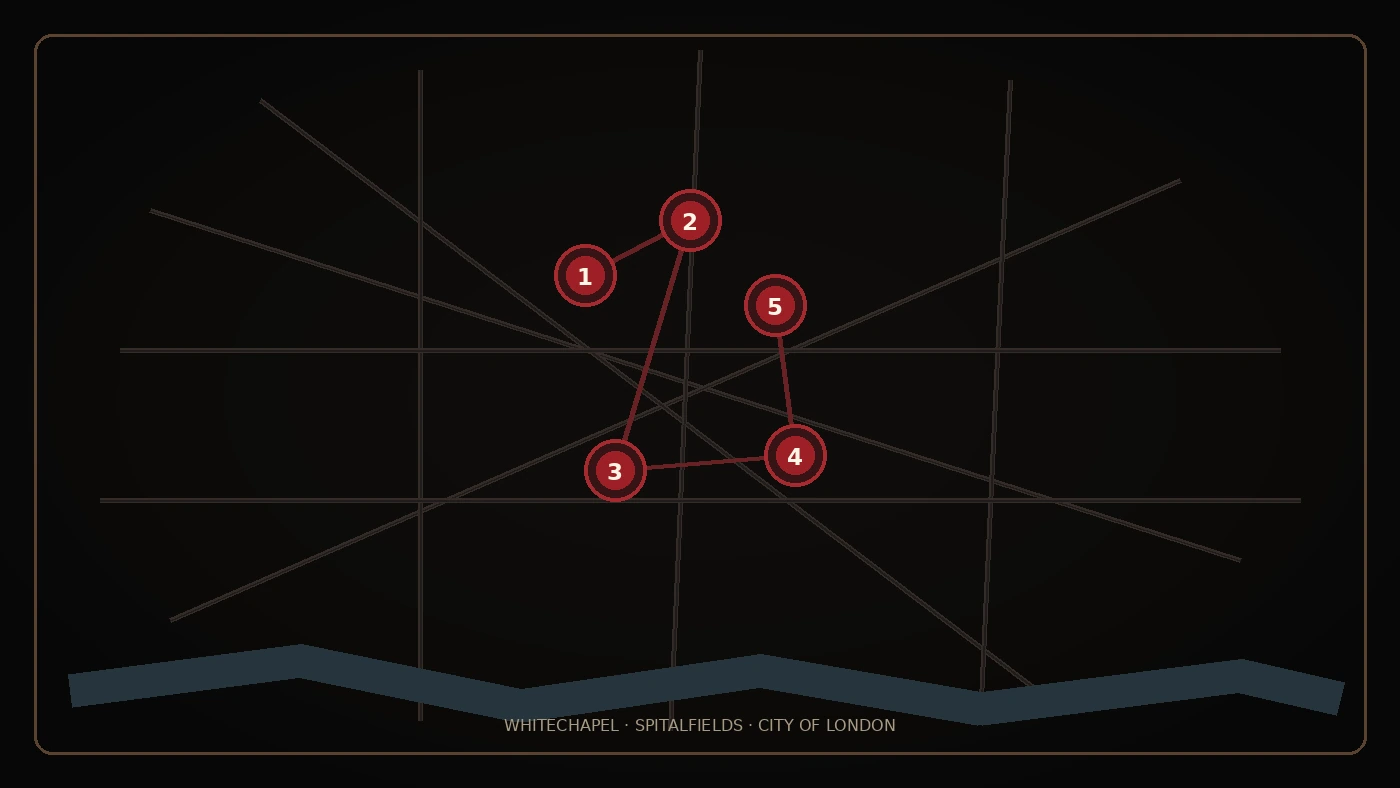
    Map showing the five canonical Jack the Ripper murder sites in modern London
    Approximate positions of the five canonical murder sites in modern Whitechapel, Spitalfields and the City of London. Open the map to view the full-size version.

    Follow the five-site walking route
    Open a chronological walking route between the approximate historic locations. Several original yards and buildings no longer exist.
    Open walking route in Google Maps ↗

    The Five Canonical Jack the Ripper Murder Sites

    The term “canonical five” refers to Mary Ann Nichols, Annie Chapman, Elizabeth Stride, Catherine Eddowes and Mary Jane Kelly. They were killed between 31 August and 9 November 1888. Other deaths formed part of the wider Whitechapel Murders investigation, but historians continue to debate whether they were connected to the same person.

    The five-site map is therefore not a map of every Whitechapel murder. It is the most commonly accepted geographical outline of the crimes attributed to Jack the Ripper.

    Research note: The surviving Metropolitan Police case papers are catalogued by The National Archives as MEPO 3/141, covering the Whitechapel murders from 1888 to 1894.

    1. Buck’s Row, Now Durward Street — Mary Ann Nichols

    Date: 31 August 1888Modern location: Durward Street, near Whitechapel stationOpen in Google Maps ↗

    Mary Ann “Polly” Nichols was found on Buck’s Row in the early hours of 31 August. The street was later renamed Durward Street and still runs just north of Whitechapel Road.

    The setting is very different today. Railway works, housing and repeated redevelopment have replaced much of the 1888 streetscape. The modern road marks the correct historic area, but there is no intact Victorian crime scene to enter. That contrast is important: the location survives, while the physical world around it largely does not.

    2. 29 Hanbury Street — Annie Chapman

    Date: 8 September 1888Modern location: Hanbury Street, SpitalfieldsOpen in Google Maps ↗

    Annie Chapman was found in the backyard of 29 Hanbury Street. In 1888, the road was lined with narrow houses, workshops and crowded yards. It ran through a district shaped by migration, tailoring, market work and severe housing pressure.

    The original number 29 was demolished, so visitors cannot stand in the old yard. Hanbury Street itself remains, cutting east from Commercial Street towards Brick Lane, but the northern side has been substantially rebuilt. Nearby streets and surviving Victorian buildings still help explain how enclosed and densely occupied the area once felt.

    For the wider social background, read what Whitechapel was really like in 1888.

    3. Dutfield’s Yard, Off Berner Street — Elizabeth Stride

    Date: 30 September 1888Modern location: Henriques Street, near Fairclough StreetOpen in Google Maps ↗

    Elizabeth Stride was found in Dutfield’s Yard, a narrow entrance beside the International Working Men’s Educational Club on Berner Street. Her death was the first of two that night, an episode later known as the “double event”.

    Berner Street was renamed Henriques Street. Dutfield’s Yard and the original club building have gone, and the surrounding block has changed substantially. The junction with Fairclough Street gives the clearest modern reference point, but the exact historic yard is no longer visible as it appeared in 1888.

    4. Mitre Square — Catherine Eddowes

    Date: 30 September 1888Modern location: Mitre Square, near AldgateOpen in Google Maps ↗

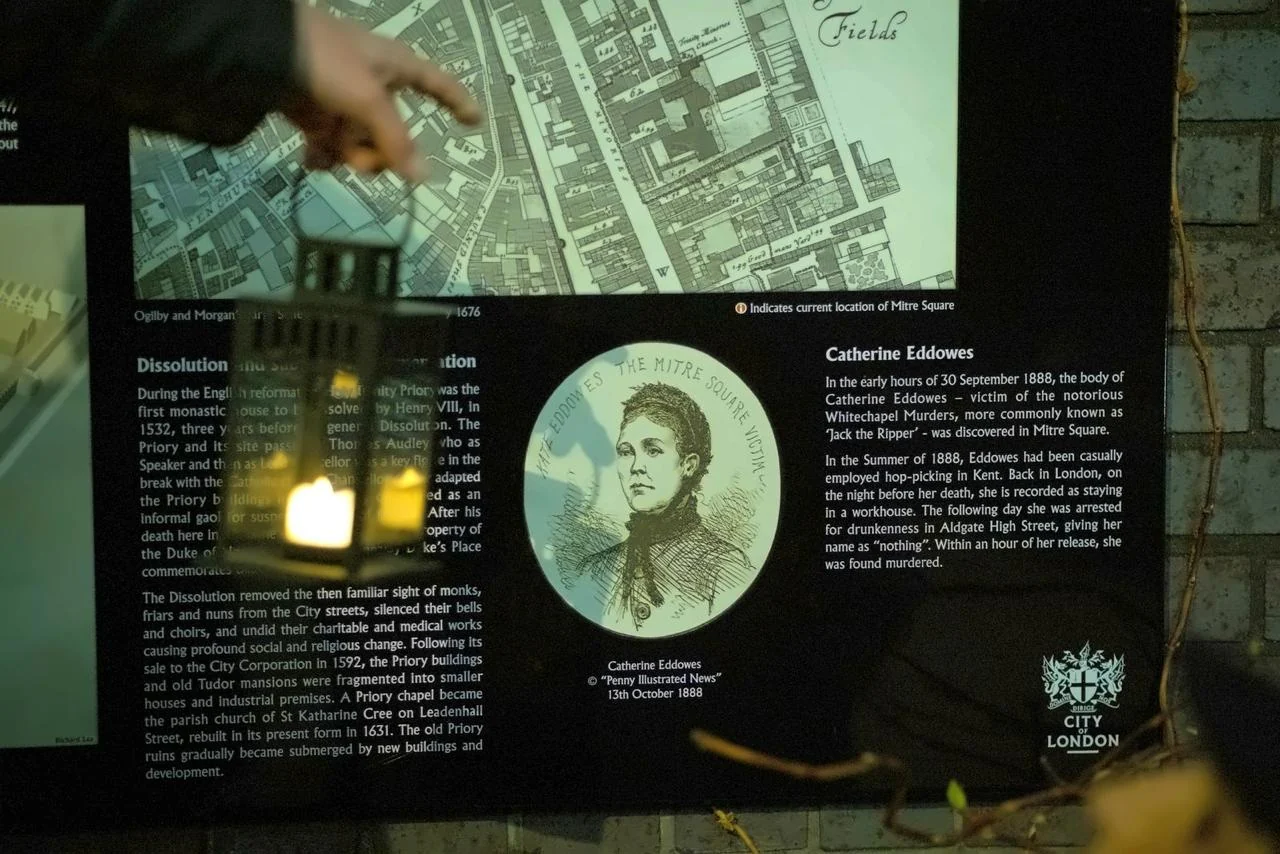
    Catherine Eddowes was found in Mitre Square less than an hour after Elizabeth Stride. This was the only one of the canonical five murders committed within the City of London rather than the Metropolitan Police district, which meant two police forces became involved that night. The City of London’s official walking guide also records Catherine Eddowes at Mitre Square.

    Mitre Square is the easiest name on this list to find on a modern map because the square still exists. Its buildings and layout have changed through successive redevelopments, so the present-day space should not be mistaken for a preserved Victorian scene. Even so, standing there makes the compact geography of the case immediately clear: Whitechapel, Aldgate and the City meet within a short walk.

    City of London information panel about Catherine Eddowes and her 1888 murder in Mitre Square, with a historic map and period portrait beside a glowing lantern.
    A City of London interpretation panel in Mitre Square recounts the murder of Catherine Eddowes, whose body was found in the square in the early hours of 30 September 1888. Photo from our Jack The Ripper Tour.

    5. Miller’s Court, Off Dorset Street — Mary Jane Kelly

    Date: 9 November 1888Modern location: the former Dorset Street area beside Commercial Street and Spitalfields MarketOpen in Google Maps ↗

    Mary Jane Kelly was killed in the room she rented at 13 Miller’s Court, reached through a passage from Dorset Street. Unlike the other canonical sites, this was an indoor location.

    Dorset Street was later renamed Duval Street and then disappeared during redevelopment. Miller’s Court no longer exists, and the former street line has been absorbed into the modern buildings around the old London Fruit and Wool Exchange site. Visitors can identify the general position near Commercial Street, but there is no surviving room, court or original frontage.

    The nearby Ten Bells remains one of the area’s best-known historic landmarks. Its connection to the case should be treated as part documented history and part later tradition, rather than as proof of where the killer went. Historic England’s Grade II listing documents the pub’s mid-nineteenth-century building and coloured tiled interior.

    What Still Survives from Whitechapel in 1888?

    Very little survives unchanged at the five murder sites themselves. The value of visiting comes from seeing the distances, street pattern and remaining Victorian landmarks together. Around the wider area you can still find nineteenth-century terraces, churches, market buildings, pubs and narrow passages that help place the documentary record in a real landscape.

    • Street names that changed: Buck’s Row became Durward Street, and Berner Street became Henriques Street.
    • Locations that disappeared: Dutfield’s Yard and Miller’s Court no longer exist.
    • A location that kept its name: Mitre Square remains on the map, although it has been rebuilt.
    • A surviving landmark: the Ten Bells still stands on Commercial Street.

    Our guide to historic Jack the Ripper pubs in Whitechapel covers several surviving places associated with the district’s social history.

    Can You Visit the Jack the Ripper Murder Sites Today?

    Yes. All five historic areas can be reached using public streets, although some exact positions are approximate and several original buildings have vanished. Mitre Square is a public space; the other sites are on or near ordinary streets and modern developments.

    Please remember that these were the places where real women lost their lives. Visit quietly, avoid disturbing residents or businesses, and do not enter private property. A responsible visit should make the history clearer without turning the locations into a spectacle.

    Why a Map Cannot Tell the Whole Story

    A map shows that the locations were tightly clustered. It cannot show how dark, crowded and socially divided the East End was, or explain the lives of the women moving through it. For that, the murder sites need to be understood alongside lodging houses, workhouses, markets, pubs, police boundaries and the rapid growth of Victorian London. The LSE’s guide to Charles Booth’s poverty maps explains how streets were classified, while the London Museum’s 1889–91 map shows the social character of Spitalfields and Whitechapel.

    It is also worth separating where the women lived from where they died. Our article on the lives and addresses of the five canonical victims adds that missing human geography.

    Explore the Locations with a Guide

    Street names, police boundaries and demolished alleys can be difficult to reconstruct while looking at modern buildings. Our Jack the Ripper walking tour in London connects the surviving streets with the evidence, the social history of Whitechapel and the lives of the victims. Rather than simply pointing at locations, our guides explain what was there in 1888, what has changed and which popular claims are disputed.

    Frequently Asked Questions

    Where are the Jack the Ripper murder sites?

    The five canonical sites are Buck’s Row, now Durward Street; 29 Hanbury Street; Dutfield’s Yard off Berner Street, now Henriques Street; Mitre Square; and Miller’s Court off the former Dorset Street. They lie across Whitechapel, Spitalfields and the eastern edge of the City of London.

    Do the original murder sites still exist?

    The geographical locations can still be identified, but most original buildings and yards have been demolished. Mitre Square retains its historic name, while Durward Street, Hanbury Street and Henriques Street preserve the broader street locations. Miller’s Court and Dorset Street have disappeared.

    Can you walk between all five locations?

    Yes, but the sites are not arranged as a simple straight route, and the most meaningful path depends on which historical landmarks and pieces of evidence you want to include. Modern traffic, private property and redevelopment also make the 1888 geography less obvious than it appears on a map.

    Which Jack the Ripper site is best preserved?

    None is preserved as an intact crime scene. Mitre Square is the most straightforward location to identify by its historic name, but the present square has been redeveloped. The wider Whitechapel and Spitalfields district contains more surviving Victorian character than the individual sites themselves.

    Why are only five sites shown?

    These are the sites associated with the “canonical five”, the group most commonly attributed to the same unidentified killer. The official Whitechapel Murders file included additional victims, and historians still debate which cases were connected.

    Sources and Further Reading

  • Who Was Jack the Ripper? The Five Most Famous Suspects, Explained

    Who Was Jack the Ripper? The Five Most Famous Suspects, Explained

    It is the question every visitor to Whitechapel asks, standing in the same fog-dampened streets where it all happened: who was Jack the Ripper? More than 135 years after the autumn of 1888, the answer still refuses to arrive. Scotland Yard opened one of the largest investigations in Victorian history, questioned more than two thousand people, and examined hundreds of suspects. And yet the most famous murderer in British history was never caught, never named, never tried.

    Suspect note: No person discussed below was proved to be Jack the Ripper. The surviving Metropolitan Police papers are held in The National Archives’ MEPO 3 collection; its catalogue explicitly warns that naming a person does not imply guilt.

    That hasn’t stopped people from trying. Over the decades, a cast of suspects has been proposed, argued over, written about, and occasionally ruined. Some are famous. Some are forgotten. A few were only added to the list in the last twenty years. In this guide, we walk through the five suspects who have generated the most enduring theories, the evidence for each, and the reasons why the case remains open.

    Five famous Jack the Ripper suspects

    Montague John Druitt: The Barrister Who Vanished

    Montague Druitt was a 31-year-old barrister and schoolteacher from a respectable Dorset family. He was also, by late 1888, a man in serious trouble. He had recently been dismissed from his teaching post at a boarding school in Blackheath, and his family had a documented history of mental illness. His mother had been committed to an asylum.

    On 1 December 1888, barely a month after the final canonical murder, Druitt disappeared. His body was found floating in the Thames at Chiswick at the end of that month, with heavy stones in his pockets. The timing was the key. If Druitt was the Ripper, the murders stopped when he died. Assistant Chief Constable Melville Macnaghten later named Druitt in an 1894 memorandum, although Macnaghten had joined the Metropolitan Police after the murders and offered no direct evidence placing Druitt in Whitechapel.

    The case for Druitt rests almost entirely on that timing and his family’s instability. There is no direct evidence placing him in Whitechapel on any of the murder dates. Modern Ripper historians are deeply divided: some consider him a strong suspect, others dismiss him as a coincidence of timing.

    Aaron Kosminski: The Polish Barber

    Aaron Kosminski was a 23-year-old Polish-Jewish hairdresser living in Whitechapel. He was admitted to Colney Hatch Asylum in 1891 with severe mental illness and spent the rest of his life in institutional care. Modern diagnostic labels should not be imposed on the surviving Victorian records without caution. A 2014 book publicised a mitochondrial-DNA claim based on a shawl said to have been found beside Catherine Eddowes. A related journal article appeared online in 2019, but its conclusions and the shawl’s provenance remain disputed; the paper now carries an expression of concern.

    But the shawl’s provenance is fiercely disputed. Critics point out that the shawl only emerged in the possession of a police officer’s descendants decades after the murders, that its chain of custody is unverifiable, and that the DNA evidence has been questioned by geneticists. Even a mitochondrial-DNA association would not, by itself, prove identity or guilt. Kosminski remains a frequently discussed suspect, and the DNA claim revived attention, but the evidence is far from conclusive.

    Michael Ostrog: The Career Criminal

    Michael Ostrog was a Russian-born thief and fraudster with a long criminal record who drifted through London’s hospitals and workhouses. He was named in a police memorandum from 1894, alongside Druitt and Kosminski, as a possible suspect. That 1894 memorandum was written by Melville Macnaghten, not Robert Anderson, and listed Druitt, Kosminski and Ostrog as possible suspects rather than proven offenders.

    Most historians now dismiss Ostrog. There is no evidence he was in Whitechapel during the murders, no physical description matching the witnesses’ accounts, and his known crimes were non-violent theft and fraud. His inclusion in the memorandum seems to have been a case of the police listing every name they had, rather than naming a prime suspect. The theory that Ostrog was the Ripper has faded for good reason.

    John Pizer: The Leather Apron

    Before the name “Jack the Ripper” existed, the press had a different monster. In early September 1888, newspapers were full of warnings about a figure they called “Leather Apron”, a man supposedly seen threatening women in Whitechapel. The description matched John Pizer, a Jewish boot-finisher who wore a leather apron for his work.

    Pizer was arrested on 10 September 1888 and quickly released when police confirmed he had airtight alibis for both of the murders committed so far. He was never a serious suspect in the investigation itself. But his story matters for a different reason: it shows how quickly fear and prejudice could turn a name into a headline. The “Leather Apron” panic foreshadowed the way the Ripper case would consume the press, and it is a reminder that some of the most famous “suspects” were victims of the era’s anti-immigrant hysteria rather than genuine leads.

    James Maybrick: The Cotton Merchant’s Diary

    No suspect has generated more controversy than James Maybrick, a Liverpool cotton merchant. In 1992, a diary surfaced claiming to be Maybrick’s confession, written in his own hand and dated 1889. The diary named him as Jack the Ripper and included details that seemed to match the murders. It was published to enormous publicity and became a bestseller.

    Almost immediately, experts began picking it apart. Handwriting analysts questioned whether the diary matched Maybrick’s known handwriting. Historians pointed out that it contained factual errors about the murders, and that the details it “predicted” had actually been published in newspapers before the diary was written. The diary’s provenance remains unexplained, and most academics regard it as a hoax, possibly created in the 1980s. The Maybrick theory lives on in books and documentaries, but the evidence against him is, in the words of one Ripper historian, “a diary that no one can prove is real”.

    The Suspects the Police Actually Considered

    It is worth remembering that the five names above are the ones that have captured the public imagination. The actual police investigation was messier. Officers questioned thousands of people, detained hundreds, and formally considered a far wider range of suspects, including butchers, slaughtermen, sailors, and even members of the medical profession, who some theorised could have possessed the anatomical knowledge displayed in the murders. One of the most persistent theories involves a member of the royal family, though it has never been supported by any credible evidence.

    What all the suspects share is a frustrating absence of certainty. The Ripper case is unique in criminal history precisely because it offers so many plausible candidates and so little proof. A century and a half of investigation has produced theories, books, documentaries, and even a diary, but no conviction. The case remains, officially, unsolved.

    Why the Case Still Fascinates Us

    Part of the answer lies in the victims. The five women murdered in Whitechapel in 1888 were among the poorest and most vulnerable people in London. They lived in the lodging houses, walked the same streets, and died in the same alleys. Their story, told properly, is not just a mystery to be solved. It is a window into the desperate world of Victorian Whitechapel and the lives of the five victims who lived there.

    Part of the answer is the atmosphere. The fog, the gaslight, the narrow courts, the sense that a killer could move unseen through one of the most crowded districts on earth. Even the name itself came from a letter that may have been a hoax.

    And part of the answer is that the mystery is genuinely unsolvable with the evidence we have. Every new suspect, every DNA claim, every rediscovered diary is examined, debated, and eventually shelved. The Whitechapel murders remain the greatest unsolved case in British history, and the suspects above are the reason why.

    Walk the Streets and Decide for Yourself

    The best way to engage with the Ripper mystery is not to read about it, but to stand where it happened. Our Jack the Ripper walking tour takes you through the actual streets of Whitechapel, past the sites associated with the murders, and into the world the victims and suspects inhabited. You will hear the evidence, weigh the theories, and, like every investigator before you, decide for yourself who you believe.

    Curious about the details of the case? Read about the pubs where the Ripper may have drunk, or ask yourself whether a Ripper tour is worth it.

    Frequently Asked Questions

    Who was the most likely Jack the Ripper suspect?

    There is no consensus. Montague Druitt and Aaron Kosminski are the two names most frequently discussed by modern historians, but neither has conclusive evidence against them. The official investigation named no one, and the case remains formally unsolved.

    How many Jack the Ripper suspects are there?

    More than 100 named individuals have been proposed as Jack the Ripper over the years, ranging from butchers and sailors to barristers and members of the royal family. The five in this guide are the ones with the most enduring and widely debated theories.

    Was Jack the Ripper ever caught?

    No. Despite one of the largest police investigations of the Victorian era, Jack the Ripper was never identified, caught, or tried. The case remains the most famous unsolved murder investigation in British history.

  • Why Was Jack the Ripper Never Caught?

    Why Was Jack the Ripper Never Caught?

    Jack the Ripper was never identified, arrested or tried. More than a century later, the likeliest explanation is not one dramatic police failure but a combination of limited forensic tools, difficult conditions in Whitechapel, conflicting testimony and an investigation overwhelmed by information.

    Evidence note: The National Archives records that the murderer was never caught despite a major police investigation. The reasons below are historical explanations, not a solved reconstruction of the case.

    Why the investigation failed

    There Was No Modern Forensic Evidence

    Victorian investigators gathered witness statements, medical evidence, physical exhibits and, in at least one case, crime-scene photographs. What they lacked were modern identification tools: routine fingerprint comparison, blood typing, DNA profiling, CCTV and searchable digital records. Evidence existed, but much of it could not reliably identify one person.

    Whitechapel Was Chaotic and Crowded

    Whitechapel was one of London’s poorest and most overcrowded districts at the time. Poor lighting, narrow courts, common lodging houses and constant movement made it difficult to establish who had been in a particular street at a particular time. A person familiar with the district could disappear quickly into the surrounding alleys and crowds.

    Related video: Watch What Jack the Ripper Saw — Whitechapel 1888 (Restored) directly on YouTube.
    Watch on YouTube ↗

    The Attacks Happened Quickly

    Investigators could estimate time of death only within a range, and the surviving evidence does not reveal exactly how each woman encountered her killer. What the crime scenes do suggest is that the attacks were carried out with limited opportunity before patrols or passers-by returned. Familiarity with the streets may have helped, but it cannot be proved.

    Witness Descriptions Conflicted

    The surviving witness accounts differ on age, height, facial hair, clothing and accent. Some witnesses may have seen unrelated men; others observed people briefly, at night and under poor lighting. The result was no single description reliable enough to identify the killer.

    Crime Scenes Were Contaminated

    Victorian crime-scene control was not standardised. Officers, doctors and members of the public could enter an area before evidence was fully documented, while objects were sometimes moved as part of the medical examination. That created opportunities for fragile evidence to be disturbed or lost.

    The Investigation Was Overwhelmed

    Police pursued large numbers of interviews, tips and suspects while also processing letters claiming to come from ‘Jack the Ripper’. Most are now treated as hoaxes, but each demanded attention and added noise to an already difficult inquiry.

    The murders also crossed policing boundaries. Most sites fell within the Metropolitan Police district, while Catherine Eddowes was killed in the City of London Police area. The forces cooperated, but nineteenth-century information sharing was slower and less centralised than it is today.

    The Killer May Have Left the Area

    The canonical series ends with the murder of Mary Jane Kelly in November 1888, but no surviving evidence explains why. Death, imprisonment, institutionalisation, relocation and simply stopping have all been proposed. None has been proved.

    A conclusive identification is now unlikely. The surviving records can test theories and eliminate exaggerations, but they do not support a criminal case against any named suspect. That distinction matters: a plausible theory is not proof.

    What the Victorian Police Actually Did

    It is easy to describe the investigation as primitive and stop there. In reality, officers increased patrols, interviewed large numbers of witnesses and suspects, searched lodging houses, circulated descriptions and followed tips from across Britain and overseas. The surviving Metropolitan Police files show the scale of the inquiry as well as its gaps.

    The problem was not an absence of effort. Investigators had no dependable way to connect a person to biological material, compare records instantly or preserve every scene to modern standards. Large quantities of information therefore produced leads without producing an identification that could survive in court.

    Could Modern DNA Solve the Case?

    Modern testing cannot compensate for an uncertain chain of custody. Objects linked to the case have passed through many hands, and contamination or an incorrect provenance can make a laboratory result historically meaningless. A 2019 journal paper examined DNA on a shawl said to be connected with Catherine Eddowes, but the identification claim remains disputed and the journal later issued an expression of concern.

    Even a genuine mitochondrial-DNA association would identify a maternal line shared by many people, not prove that one named person committed the murders. Without a securely documented object and a complete evidential chain, DNA cannot turn a disputed theory into a solved case.

    Why the Case Remains Unsolved

    The case remains unsolved because the investigation produced no reliable identification before evidence degraded and witnesses disappeared. It also became a lesson in the power of media attention: publicity generated leads, but hoaxes and sensational reporting complicated the work. The responsible conclusion is not that one suspect has secretly been proved; it is that the surviving evidence leaves the killer’s identity unknown.

    Examine the evidence where the investigation unfolded
    Our guides connect the surviving streets, police records and disputed theories so you can reach your own conclusion without pretending the case has been solved.
    Explore our Jack the Ripper tour →

    Frequently Asked Questions

    Why was Jack the Ripper never caught?

    No single failure explains it. Limited forensic methods, crowded streets, conflicting witness accounts, disturbed evidence, hoax correspondence and an overwhelming number of leads all reduced the chance of identifying one person.

    Did Victorian police have fingerprints or DNA?

    No. Police collected statements, medical observations and physical evidence, but routine fingerprint identification, blood typing and DNA profiling were not available to the 1888 investigation.

    Did the Metropolitan Police and City of London Police work together?

    Yes. They cooperated after Catherine Eddowes was killed in the City of London Police area, while most other canonical sites fell within the Metropolitan Police district. Communication and record-sharing were nevertheless far slower and less centralised than today.

    Could DNA identify Jack the Ripper today?

    Only if material had a secure, documented connection to a crime scene and an uncontaminated chain of custody. The best-known shawl claim is disputed, and the related journal paper now carries an expression of concern.

    Is there a proven Jack the Ripper suspect?

    No. Several people remain plausible subjects of historical debate, but the surviving evidence does not prove that any named suspect committed the five canonical murders.

    If you enjoyed this, explore the five most famous Jack the Ripper suspects — the theories, the evidence, and the men behind them.

  • Is a Jack the Ripper Tour Worth It?

    Is a Jack the Ripper Tour Worth It?

    Each evening, visitors walk through Whitechapel to explore one of history’s most enduring unsolved mysteries. The question is: should you be one of them?

    The honest test: A Ripper tour is worth it when the guide adds historical context, keeps the group manageable and treats the five women as people. If it offers only gore and theatrical fog, give it a miss.

    If you’ve been wondering whether a Jack the Ripper tour is actually worth your time and money, or whether it’s just a tourist trap dressed up in Victorian clothing, this is the honest answer you’re looking for.

    The Short Answer: Yes — But It Depends on the Tour

    A Jack the Ripper tour can be one of the most memorable things you do in London. It can also be a disappointment. The difference almost entirely comes down to the quality of your guide and the size of your group.

    Done well, a Ripper tour isn’t just a ghost walk. It’s a window into 1888 London, the poverty of the East End, the failures of the Victorian justice system, the real lives of the five women who were killed, and the genuine mystery that has never been solved. You leave with a sense of the city that no museum exhibit can replicate.

    Done badly, it’s a guide reading facts off a phone to a group of 40 strangers in the rain.

    So before you dismiss or book, here’s what you should know.

    What You Actually Get on a Jack the Ripper Tour

    A good Jack the Ripper walking tour takes you through the streets of Whitechapel and Spitalfields in London’s East End — the same area where the murders took place in the autumn of 1888. You’ll visit the actual locations where the victims were discovered, hear the stories behind each crime, and get a feel for what this part of London looked and felt like at the time.

    The best tours weave in the social history too — the poverty, the overcrowding, the politics — because that context is what makes the story genuinely compelling rather than just gruesome. The crimes unfolded in a particular place and historical moment, and that social context shaped both the lives of the women and the police investigation.

    Most tours last around two hours and cover roughly a mile and a half on foot. The area is compact and walkable. Parts of the historic street pattern can still be traced, although many original buildings, yards and courts have disappeared.

    Practical Details to Check Before Booking

    A tour can be historically excellent and still be the wrong fit if the practical details do not suit you. Check the duration, walking distance, age guidance, accessibility and cancellation terms before paying.

    • Time and distance: our evening tour lasts approximately two hours and covers about 1.5 miles at a gentle pace.
    • Age guidance: because the subject concerns real historical murders, we recommend it for ages 12 and above, with parental discretion.
    • Accessibility: cobbled streets and narrow passages can be challenging for wheelchairs and strollers, so contact us before booking if you have mobility concerns.
    • Weather: the tour normally runs in rain, so comfortable shoes and suitable clothing matter more than theatrical atmosphere.

    Who Gets the Most Out of It

    A Jack the Ripper tour tends to hit differently depending on what you’re bringing to it.

    • You’ll love it if you: enjoy true crime, are curious about Victorian history, want to see a side of London most tourists miss, or simply love a good story told in the right setting.
    • It might not be for you if: you’re expecting jump-scares and horror theatrics, or you want a fast-paced highlight reel of the city. This is a walking tour with substance — it rewards curiosity.
    • Is it suitable for children? We’d suggest 12 and above. The content deals with historical murders and can be discussed in a thoughtful, age-appropriate way, but it’s not designed for young children.

    What to Look for in a Good Tour

    Not all Ripper tours are created equal. Here’s what separates a memorable experience from a mediocre one:

    • Small group size. Very large groups make it harder to hear, ask questions and absorb each location. Look for a tour that keeps its group small enough for genuine interaction with the guide.
    • A knowledgeable guide. The best guides know this case deeply and can go beyond the Wikipedia version. They can answer questions, share lesser-known details, and handle the history with respect.
    • Authentic storytelling. The Ripper case isn’t a pantomime. The best tours treat the victims as real people with real lives — not props in a horror story.
    • The right pace. You want time to absorb each location, not a rushed march from stop to stop.

    Why Whitechapel at Night Hits Differently

    You can read about Jack the Ripper anywhere. But standing near Commercial Street at dusk, with the surviving street pattern around you, offers spatial context that a book cannot reproduce.

    The East End has changed enormously since 1888, but enough of the original streets, pubs, and architecture remain to make the experience feel genuinely connected to the past. The Ten Bells pub, long associated with the case in later accounts, still stands on the corner of Commercial Street. Hanbury Street, where Annie Chapman was found, is still there. The geography makes the history real in a way that’s hard to explain until you’ve experienced it.

    That’s ultimately why a Jack the Ripper tour is worth it, not because of the horror, but because of the humanity.

    What a Tour Cannot Preserve

    A responsible tour should be honest about what has disappeared. Several original yards and buildings were demolished, and no location survives as an intact crime scene. The value of a guide is not pretending modern London is frozen in 1888; it is reconstructing the street pattern, evidence and social context around what remains. Our map of the murder sites today shows which positions are exact, approximate or substantially redeveloped.

    Ready to See Whitechapel for Yourself?

    Ready to decide for yourself?
    Our small-group experience covers approximately 1.5 miles through Whitechapel with an expert storyteller, connecting the evidence with what remains of the 1888 landscape.
    See tour details and availability →

  • The Dear Boss Letter: How Jack the Ripper Got His Name

    The Dear Boss Letter: How Jack the Ripper Got His Name

    Everyone knows the name Jack the Ripper. It’s one of the most recognisable monikers in the history of crime, a name that has inspired films, books, walking tours, and endless theories for nearly 140 years. But here’s something that surprises most people when they first hear it: the name may have been created by a journalist rather than the killer.

    Primary-source note: The National Archives catalogues the original “Dear Boss” letter as MEPO 3/3153: dated 25 September 1888 and addressed to the Central News agency. Its authorship has never been established.

    This is the story of a single letter, dated 25 September 1888, that changed everything — and may have been a hoax all along.

    Before the Name: “The Whitechapel Murderer”

    In the summer and early autumn of 1888, a killer was stalking the streets of Whitechapel in London’s East End. By the end of September, four of the five canonical victims had been murdered: Mary Ann Nichols, Annie Chapman, and then Elizabeth Stride and Catherine Eddowes in the ‘Double Event’ on 30 September. The ‘Dear Boss’ letter was dated five days earlier, before the double murder, and was later forwarded to the police.

    The press were covering the murders obsessively, but they had no name for the killer. Newspapers referred to him as “the Whitechapel Murderer” or more sensationally “Leather Apron”, a nickname that had emerged from early witness descriptions of a man seen intimidating women in the area. It was dramatic enough, but nothing like what was coming.

    The Letter That Changed Everything

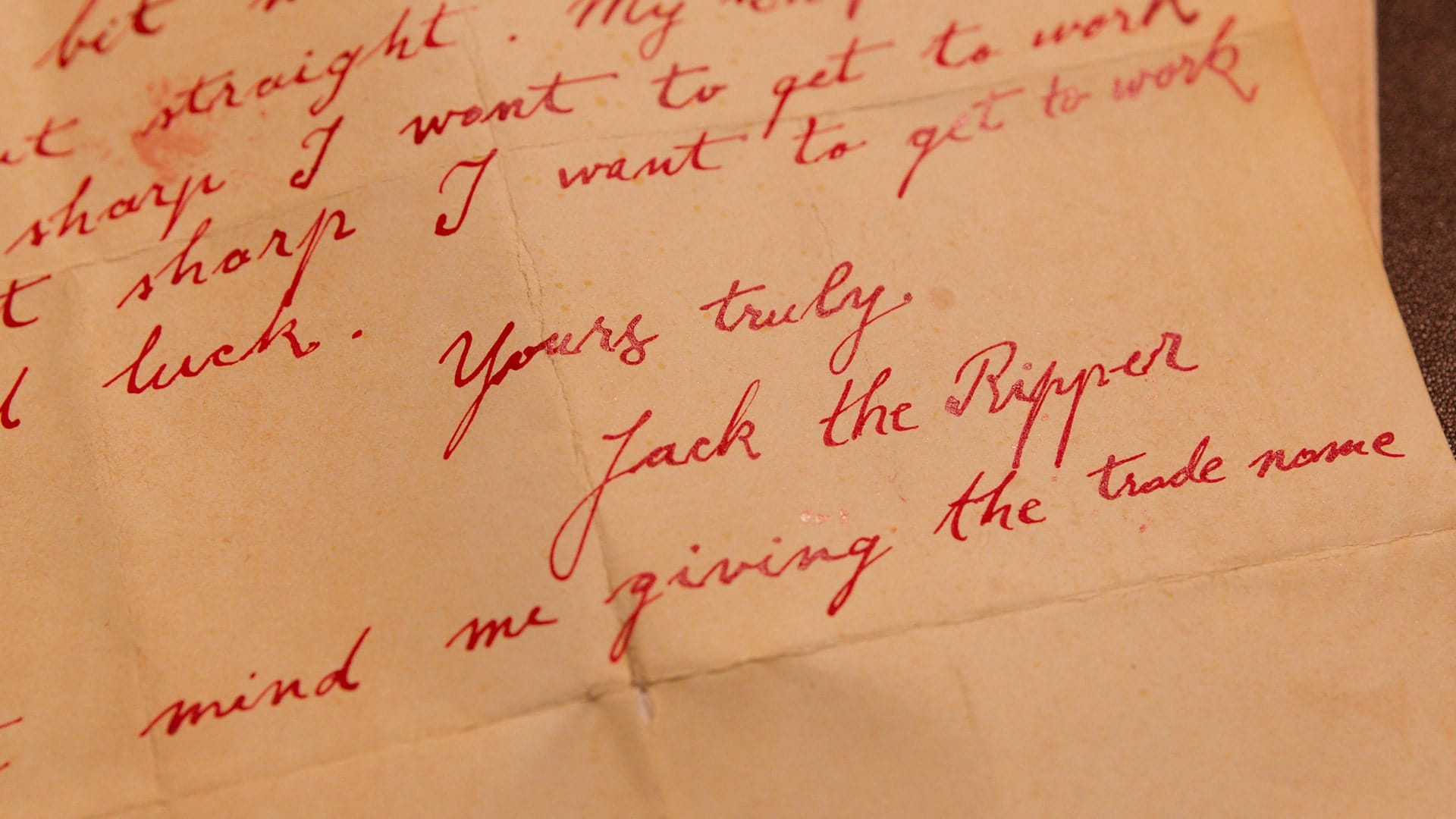
    On 27 September 1888, a letter arrived at the offices of the Central News Agency in London. It was written in red ink, in a confident, somewhat mocking hand, and it was addressed simply: “Dear Boss.”


    The letter read, in part:

    “I keep on hearing the police have caught me but they wont fix me just yet. I have laughed when they look so clever and talk about being on the right track. That joke about Leather Apron gave me real fits. I am down on whores and I shant quit ripping them till I do get buckled.”

    And then, near the end, the writer signed off:

    “Yours truly, Jack the Ripper”

    It was the first time that name had ever appeared in writing. The Central News Agency forwarded the letter to Scotland Yard on 29 September. The ‘Double Event’ murders followed during the night of 30 September, and on 1 October a follow-up postcard arrived, also signed ‘Jack the Ripper’ and referring to the two killings. This second piece of correspondence became known as the “Saucy Jacky” postcard.

    Scotland Yard made a decision that would cement the name forever: they released facsimiles, printed copies, of both communications to the press on 3 October 1888, hoping that someone would recognise the handwriting. Instead, they handed the Victorian media the story of the century. Within days, the name Jack the Ripper was on the front page of every newspaper in Britain.

    A Media Sensation, and a Flood of Copycats


    The public reaction was immediate and extraordinary. The name caught something that “Leather Apron” never had: it was vivid, theatrical and instantly memorable. Within weeks, Scotland Yard was receiving hundreds of letters, all claiming to be from “Jack the Ripper,” most of them copying phrases and style from the original Dear Boss letter.

    The vast majority were obvious hoaxes, and the police knew it. The effect was already irreversible. The name had taken on a life of its own.

    Was It a Hoax All Along?

    Here’s where the story takes a genuinely fascinating turn. In the years following the murders, senior police officials began expressing serious doubts about the letter’s authenticity. Chief Inspector John Littlechild and other investigators came to believe that the Dear Boss letter and the Saucy Jacky postcard were not written by the killer at all, but by a journalist, looking to keep the story alive.

    In 1931, those suspicions crystallised into something more specific. Journalist Fred Best was later reported to have claimed that he and another newspaperman created Ripper communications to sustain public interest. The account is disputed and should be treated as a reported confession, not proof of authorship.

    Think about what that means for a moment. The most famous alias in criminal history may have been invented in a newsroom, not by a killer.

    Modern linguistic research has suggested that the ‘Dear Boss’ letter and ‘Saucy Jacky’ postcard probably shared an author, but it does not identify that person or prove a journalistic hoax. In 2018, Andrea Nini, a forensic linguist at the University of Manchester, published research on the authorship of the Ripper letters concluding that the Dear Boss letter and the Saucy Jacky postcard were probably written by the same person — suggesting a common author behind both, rather than an impulsive killer dashing off correspondence between murders. If the letters share an author, and that author wasn’t the Ripper, then the “Jack the Ripper” name is one of the most consequential examples of media myth-making in criminal history.

    Why Does It Matter?

    It matters for several reasons, and not just as a historical curiosity.

    First, it’s a reminder of how powerfully a name can shape a story. Before the Dear Boss letter, the Whitechapel murders were a horrifying local crime story. After it, they became a global sensation, with a named, almost mythologised villain at the centre. The name gave the public something to latch onto, something almost fictional in its drama. It made “Jack the Ripper” feel like a character rather than a crime.

    Second, it raises a genuine ethical question that still feels relevant today: to what extent did the press of 1888 amplify — or even partly create — the terror that gripped London? The Victorian popular press was fiercely competitive, often sensationalist and governed by far fewer formal controls than modern newsrooms. If Fred Best’s confession is accurate, then journalists didn’t just cover the story. They wrote themselves into it.

    Third, and perhaps most intriguingly: if the letters were a hoax, then we’ve been calling this killer by the wrong name for nearly 140 years. The Whitechapel Murderer is still unidentified. But “Jack the Ripper” — a name that may have been created for publicity — has outlasted every suspect, theory and investigation.

    Where Is the Letter Now?

    The original ‘Dear Boss’ letter is held by The National Archives within the Metropolitan Police records, catalogued as MEPO 3/3153. A facsimile is reproduced in numerous books and online archives, and it remains one of the most studied documents in criminal history.

    If you’re visiting London, the letter’s story is a central part of most serious Jack the Ripper walking tours in London — and understanding it changes how you see the whole case. Because before you can ask “who was Jack the Ripper?”, it’s worth asking a more unsettling question first: who decided to call him that?

    The answer may have been a journalist seeking publicity — but the author has never been established. What is certain is that the name outlived the investigation that produced it.

    The name stuck. The man never did. Dive into the five most famous suspects behind the name.

  • Jack the Ripper Pubs in Whitechapel: Historic Pubs Connected to the Ripper

    Jack the Ripper Pubs in Whitechapel: Historic Pubs Connected to the Ripper

    There are few places in the world where history feels as close as it does on the back streets of Whitechapel after dark. The cobblestones, the narrow alleyways, and the amber glow of old streetlamps all conspire to pull you back to 1888 — the year London was gripped by fear, and the East End became the hunting ground of history’s most infamous unidentified killer.

    Heritage note: Of the pubs discussed below, the Ten Bells has the clearest official heritage record. Historic England lists it at Grade II and describes the surviving mid-nineteenth-century building and tiled interior. Other Ripper associations should be read as a mixture of documented history and later tradition.

    But the story of Jack the Ripper isn’t just one of dark alleyways and police reports. Much of it played out in the warmth and noise of the local pub. In Victorian Whitechapel, the pub was an important part of working-class social life. It was where people gathered after long shifts in the markets and where lodging-house residents spent their evenings. Some pubs later became associated with the victims, though those traditions are not equally well documented. Pubs were woven into everyday life across Whitechapel, and a handful of historic venues or successor buildings still help visitors understand the district’s social geography.

    If you’re visiting London and want a truly atmospheric window into Victorian history, here are the pubs you need to know about.

    Five Whitechapel pubs connected to the case

    The Ten Bells, The Most Famous Ripper Pub

    84 Commercial Street, Spitalfields, E1 6LY

    Map: Open the Ten Bells at 84 Commercial Street in Google Maps.
    Open in Google Maps ↗

    If there’s one pub that defines the Jack the Ripper story, it’s the Ten Bells. Standing on the corner of Commercial Street and Fournier Street, directly opposite the magnificent Christ Church Spitalfields, it has been serving East End Londoners since at least the mid-18th century — and it hasn’t lost an ounce of its Victorian character.

    The pub’s name has shifted over the years, always tied to the number of bells in the church peal next door. In the 18th century it was called the Eight Bells; by 1794, records show it had become the Ten Bells, after the church added more chimes. That name has stuck ever since — barring a controversial interlude from 1976 when it was briefly renamed “The Jack the Ripper” to capitalise on its history, before public pressure, led by the Reclaim the Night campaign, restored the original name in 1988.

    Later accounts associate Annie Chapman with the Ten Bells on the morning of 8 September 1888, but the identification is disputed and does not appear securely in the surviving official evidence.

    Mary Jane Kelly is also linked to the pub in later witness and press accounts. Those reports are historically interesting, but they should not be treated as conclusive proof that she was a regular or that her movements on the final evening are known with certainty.

    Today, the Ten Bells is a Grade II listed building with a beautifully preserved Victorian interior. Its best-documented historic feature is the coloured nineteenth-century tiled interior, including the mural Spitalfields in ye Olden Time. It’s atmospheric, historic, and genuinely lovely, well worth a visit whether you’re a Ripper enthusiast or simply a fan of a well-preserved Victorian pub.

    The White Hart, Ripper Corner

    89 Whitechapel High Street, E1 7RA

    Map: Open the White Hart on Whitechapel High Street in Google Maps.
    Open in Google Maps ↗

    The White Hart is a pub with serious Ripper credentials, though they come from a slightly different angle. A basement barber’s shop at the White Hart was later associated with Severin Klosowski, who used the name George Chapman. That connection appears to date from around 1890, after the Whitechapel murders, and does not prove he was the killer.

    The pub also sits uncomfortably close to the site of the very first possible Ripper killing. On 7 August 1888, Martha Tabram was stabbed 39 times in a stairwell on nearby George Yard — just 50 feet from the back of the White Hart. The murder site was nearby, but proximity alone does not establish that Tabram drank at the White Hart, and standard accounts more often place her at another pub.

    The White Hart retains a historic pub presence on this prominent corner, but the building and business have changed over time. Its atmosphere should not be mistaken for an untouched 1888 interior. It’s long been a gathering point for Ripper researchers and enthusiasts, the famous corner table near the back has become known simply as “Ripper Corner”, where regulars swap theories, swap anecdotes, and argue over the identity of the Ripper over a pint. If you’re visiting with a genuine interest in the case, this is the pub where you’re most likely to end up in conversation with a fellow obsessive.

    The Alma, Spelman Street

    41 Spelman Street, E1 5LQ

    Map: Open the Alma on Spelman Street in Google Maps.
    Open in Google Maps ↗

    A little off the main tourist trail, the Alma on Spelman Street is worth seeking out. Its upper floor has been decorated with an impressive collection of Ripperana — original posters, artwork, and reproductions of Victorian newspaper reports covering the murders. It’s a more intimate, neighbourhood pub feel compared to the Ten Bells, but that’s part of its charm. It offers a quieter space to absorb the history away from the busier streets.

    The Britannia, A Pub Lost to Time

    The original Britannia pub once stood on the corner of Dorset Street — directly opposite the Ten Bells and at the heart of what was then one of London’s most notorious slum streets. Annie Chapman was known to drink here, and it was in this pub that she became embroiled in an argument with a woman named Eliza Cooper over a bar of soap, leading to a physical fight. The bruising from that brawl was still visible on Annie’s body at her autopsy, just days later.

    The Britannia no longer exists, the building was demolished long ago, but the site is just steps from the Ten Bells, and a walk through what is now Duval Street (formerly Dorset Street) still carries a certain weight.

    The Kings Stores, A Curious Footnote

    Corner of Widegate Street and Sandy’s Row, E1

    Map: Open the Kings Stores on Widegate Street in Google Maps.
    Open in Google Maps ↗

    The Kings Stores has a large sign above the door declaring “Jack the Ripper Last Seen Here 1888.” There’s just one problem: the pub doesn’t appear in any serious Ripper literature, and there’s no historical basis for the claim. It’s a great example of how the Ripper legend has been enthusiastically embraced by the local hospitality trade, sometimes more for atmosphere than accuracy.

    That said, it’s an interesting stop, and the pub itself has a decent amount of Victorian character. Just take the signage with a generous pinch of salt.

    Tips for Visiting

    The best time to explore Whitechapel’s Ripper pubs is in the evening, ideally in autumn or winter when the streets take on a darker, more atmospheric quality. Most of the key Jack the Ripper locations are within easy walking distance of each other, clustered around Commercial Street, Whitechapel High Street, and Brick Lane.

    A well-researched Jack the Ripper walking tour in London can place these pubs in their wider historical setting while distinguishing documented evidence from later folklore.

    A few practical notes: the Ten Bells can get busy on weekends, so weekday evenings are better if you want to soak up the atmosphere at your own pace. The White Hart is smaller and more local in character, great for a longer, quieter stay.

    Whitechapel has changed enormously since 1888. The old slums are long gone, replaced by a lively, diverse neighbourhood full of Bangladeshi restaurants, vintage shops, and street art. But stand outside the Ten Bells on a cold November evening, look up at the spire of Christ Church, and it’s not hard to imagine the world Mary Kelly walked through on the last night of her life.

    Put the pubs in their historical setting
    Our evening walk connects surviving landmarks with the murder sites, police boundaries and the lives of the women—without treating later pub folklore as fact.
    Explore our Jack the Ripper tour →

    Frequently Asked Questions

    Which historic pubs are worth visiting in Whitechapel?

    The Ten Bells is the clearest choice for documented architectural heritage and Victorian atmosphere. The White Hart and the Alma offer different parts of the modern East End pub experience, but the strength of their claimed connections to the Ripper case varies.

    Which pub has the strongest Jack the Ripper connection?

    The Ten Bells is the best-known surviving pub associated with the case and has the strongest official heritage record. Specific claims about individual victims still require caution because much of the pub lore comes from later accounts.

    Is the Ten Bells the original building?

    Historic England records the present building as mid-nineteenth century, which means it was standing in 1888. A pub existed on or near the site earlier, but the current building should not be described as unchanged since its earliest foundation.

    Can you walk between the Whitechapel pubs?

    Yes. The surviving pubs discussed here are within the wider Whitechapel and Spitalfields area, although the most useful route depends on current opening times and which historical locations you want to include.

    Are all Jack the Ripper pub stories true?

    No. Some claims are supported by heritage records or contemporary reporting; others are later traditions, commercial stories or speculation. A pub’s proximity to a murder site does not by itself prove that a victim or the killer visited it.

    The pubs of Whitechapel aren’t just tourist attractions — they’re some of the last surviving physical links to one of history’s most enduring mysteries. Raise a glass, listen to the stories, and see what you think.

  • Jack the Ripper Victims: Who Were the Canonical Five?

    Jack the Ripper Victims: Who Were the Canonical Five?

    Jack the Ripper’s five canonical victims were Mary Ann “Polly” Nichols, Annie Chapman, Elizabeth Stride, Catherine Eddowes and Mary Jane Kelly. They were killed in or close to Whitechapel between 31 August and 9 November 1888. The phrase “canonical five” is useful shorthand, not proof that every murder was committed by one person.

    A note on the women: This guide centres the women’s lives and circumstances rather than treating them as scenery in the killer’s story. Contemporary newspapers repeatedly stereotyped them, but The National Archives notes that none was known to police as a sex worker and that witnesses described several forms of casual work. London Museum likewise stresses that only Mary Jane Kelly is known to have been working in the sex trade at the time of her death.

    The five Jack the Ripper victims in order

    The five women most commonly linked to Jack the Ripper were killed during a period of just over ten weeks:

    01
    Mary Ann “Polly” Nichols31 August 1888 · Buck’s Row
    02
    Annie Chapman8 September 1888 · 29 Hanbury Street
    03
    Elizabeth Stride30 September 1888 · Dutfield’s Yard
    04
    Catherine Eddowes30 September 1888 · Mitre Square
    05
    Mary Jane Kelly9 November 1888 · 13 Miller’s Court

    Their deaths form the core sequence in most histories of the case. You can see the dates alongside the wider investigation in our Jack the Ripper timeline, or explore the locations on our interactive murder-sites map.

    Why are they called the canonical five?

    “Canonical five” is a later shorthand for the five murders most often attributed to Jack the Ripper; it was not a formal contemporary police category. The police investigation covered a broader group of Whitechapel murders, and the label does not mean investigators proved beyond doubt that one person killed all five women.

    The attacks happened within a short period and a compact part of east London. London Museum explains that similarities led contemporary investigators to connect these five cases, although the wider inquiry considered other deaths too. Four of the women were killed outdoors; Mary Jane Kelly was killed inside her room. Elizabeth Stride’s injuries also differed from those of the other four, leading to a long-running theory that her attacker may have been interrupted.

    The safest historical answer is therefore simple: five women are most consistently grouped together, while the exact number of victims remains uncertain.

    Who were the five victims?

    The women came from different backgrounds. Some had been married, some were mothers, and each had worked in ways available to working-class women in Victorian Britain. By 1888, all were living with severe financial insecurity in or around Whitechapel.

    Mary Ann “Polly” Nichols

    Mary Ann Nichols was the first of the canonical five. She had been married and had children, but by 1888 she was separated from her husband and moving between workhouses and common lodging houses. Nichols had recently moved from 18 Thrawl Street to the White House at 56 Flower and Dean Street. During her final night she was also seen around Thrawl Street and was unable to secure a bed.

    She was last seen walking through Whitechapel in the early hours. Her body was discovered shortly afterwards in Buck’s Row, now called Durward Street. The short distances between the lodging houses she used and Buck’s Row show how concentrated these streets and nightly accommodation were.

    Key locations: 18 Thrawl Street, 56 Flower and Dean Street, and Buck’s Row, now Durward Street.

    Annie Chapman

    Annie Chapman had also been married and had children. Ill health, separation and poverty shaped her later years. She supported herself through casual work, including crochet and flower selling, while staying at Crossingham’s Lodging House at 35 Dorset Street.

    Unable to pay for her bed on the night of 7–8 September, she left the lodging house. Her body was found in the backyard of 29 Hanbury Street. The yard was reached through a passage used by the building’s residents, a reminder that these murder sites were part of ordinary, crowded domestic spaces.

    Key locations: 35 Dorset Street and 29 Hanbury Street.

    Elizabeth Stride

    Elizabeth Stride was born in Sweden and moved to London as a young woman. She married John Stride and helped run a coffeehouse. After the relationship ended, she lived intermittently in common lodging houses and earned money through cleaning and other casual work.

    She was staying at 32 Flower and Dean Street in September 1888. Her body was discovered in Dutfield’s Yard off Berner Street, now Henriques Street, at about 1am on 30 September.

    Stride’s death began what became known as the “Double Event”. Because her injuries differed from those of the other four canonical victims, historians still debate whether she was killed by the same person.

    Key locations: 32 Flower and Dean Street and Dutfield’s Yard.

    Catherine Eddowes

    Catherine Eddowes had spent years travelling and working with her partner, Thomas Conway, and later lived with John Kelly. Shortly before her death, she and Kelly returned to London after seasonal hop picking in Kent.

    On 29 September she was taken into police custody for drunkenness and released at about 1am. Her body was found in Mitre Square less than an hour later. She was the second woman killed during the Double Event, after Elizabeth Stride.

    Eddowes used 55 Flower and Dean Street as a lodging address, only a short distance from Stride’s lodging. That proximity reflects the concentration of cheap accommodation; it does not prove that the two women knew one another.

    Key locations: 55 Flower and Dean Street and Mitre Square.

    Mary Jane Kelly

    Mary Jane Kelly remains the least securely documented of the five women. Much of what is known about her early life came from accounts she gave to people who knew her, and some details cannot now be verified.

    Unlike the other four canonical victims, Kelly rented a small room at 13 Miller’s Court, off Dorset Street. She was killed there on 9 November 1888. The indoor setting differed significantly from the four earlier outdoor crime scenes.

    Miller’s Court and most of Dorset Street have disappeared beneath later redevelopment. The loss of the buildings makes contemporary maps, witness statements and careful on-location interpretation especially important.

    Key location: 13 Miller’s Court, off Dorset Street.

    What did the women have in common?

    The five women were not one interchangeable group. They had different childhoods, relationships, jobs and routes into Whitechapel. What they shared by 1888 was economic insecurity.

    • All five were living in poverty at the time of their deaths.
    • All faced housing insecurity. Four relied heavily on common lodging houses; Kelly rented a room but was substantially behind with the rent.
    • Several relied on casual work and nightly lodging houses.
    • Some had experienced separation, poor health, addiction or violence.
    • Their lives unfolded within a society offering working-class women little financial protection.

    The National Archives cautions against the familiar claim that all five were prostitutes. None was known to police as a sex worker, and people who knew them described casual jobs including cleaning and hop picking. London Museum identifies Mary Jane Kelly as the only one known to have been working in the sex trade when she was killed.

    That distinction matters. The “fallen women” stereotype shifted attention away from the victims and helped generations of retellings reduce their lives to the manner of their deaths.

    Were there other possible Jack the Ripper victims?

    Yes—other violent deaths in Whitechapel before and after the Canonical Five have been proposed as possible Ripper murders. The surviving evidence is not strong enough to establish the killer’s exact total.

    The National Archives notes that at least three other murders of women in the surrounding period were violent enough to prompt later speculation. London Museum reaches the same cautious conclusion: other cases have been linked to the Ripper, but we cannot be certain how many people the murderer killed.

    This is why “five confirmed victims” is too strong. “The five women most commonly attributed to Jack the Ripper” is more accurate.

    Where did the victims live?

    The women’s lodging addresses clustered around Thrawl Street, Dorset Street and Flower and Dean Street. All lay within a compact area of Whitechapel and Spitalfields where cheap nightly accommodation was concentrated.

    That geography was produced by economics rather than coincidence. Common lodging houses offered beds to people who could not afford conventional rent. If a resident lacked the nightly fee, there was rarely any safety net between a bed and the street.

    Several original streets and buildings have since been renamed or demolished. Our interactive Jack the Ripper map marks the five murder sites and explains what survives at each location. For the wider social setting, read what Whitechapel was really like in 1888.

    Frequently asked questions

    How many victims did Jack the Ripper have?

    Five women are most commonly attributed to Jack the Ripper, but the precise number is unknown. Other Whitechapel murders have been proposed as connected cases.

    What were the victims’ names in order?

    Mary Ann Nichols, Annie Chapman, Elizabeth Stride, Catherine Eddowes and Mary Jane Kelly.

    Who was the first Jack the Ripper victim?

    Mary Ann “Polly” Nichols, killed on 31 August 1888, is regarded as the first of the Canonical Five.

    Who was the last canonical victim?

    Mary Jane Kelly, killed at 13 Miller’s Court on 9 November 1888, was the fifth and last canonical victim.

    Do we know that the same person killed all five women?

    No. Similarities, timing and geography led investigators and later historians to group the cases, but no offender was identified and the surviving evidence cannot establish the sequence with certainty.

    Walking through the history today

    Much of the physical Whitechapel of 1888 has vanished. Buck’s Row survives under a different name; Mitre Square has been redeveloped; Dorset Street, Flower and Dean Street, Dutfield’s Yard and Miller’s Court have been transformed or erased.

    Yet the distances remain revealing. Walking between the locations shows how close the lodging houses, markets, pubs, police stations and murder sites were. It turns an abstract crime story back into a real neighbourhood inhabited by real people.

    Our Jack the Ripper walking tour in London follows this geography with the women’s lives, the police investigation and the changing streets of Whitechapel at the centre of the story—not just the mythology surrounding an unidentified killer.

    Continue exploring: Compare the leading theories in our guide to the best-known Jack the Ripper suspects, or follow the entire case through the 1888 timeline.
    Further reading: The National Archives and London Museum.

  • What Was Whitechapel Really Like in 1888?

    What Was Whitechapel Really Like in 1888?

    When people think of Victorian London, they often imagine grand architecture, horse-drawn carriages, and the elegance of the British Empire at its peak. But in the autumn of 1888, just a short walk east from the gleaming spires of the City of London, a very different world existed.

    Research note: The LSE’s guide to Charles Booth’s poverty maps explains how individual London streets were classified by income and social class, while The National Archives’ Spitalfields history documents the area’s lodging houses, migration and redevelopment.

    Whitechapel in 1888 was a place of crushing poverty, overcrowded lodging houses, and desperate lives. It was here, in these dark, narrow streets, that Jack the Ripper would carry out the most infamous murders in British criminal history. But to truly understand these crimes, you first need to understand the world in which they occurred.

    Living conditions in Whitechapel

    A District of Desperate Poverty

    By the late 1880s, Whitechapel had become one of the most impoverished areas in all of London. The district sat just outside the ancient walls of the City, and for centuries it had served as a refuge for those who could not afford to live within.

    Charles Booth, the social researcher who famously mapped London’s poverty in the 1880s, coloured much of Whitechapel in black and dark blue – the shades indicating “very poor” and “semi-criminal” populations. The streets around Flower and Dean Street were described by police as “perhaps the foulest and most dangerous street in the whole metropolis.” Dorset Street, where Jack the Ripper’s final victim Mary Jane Kelly lived, earned the grim title of “the worst street in London.”

    The Yiddish theatre actor Jacob Adler, writing of his arrival in Whitechapel in 1883, recalled: “Never in Russia, never later in the worst slums of New York, were we to see such poverty as in the London of the 1880s.”

    Life in the Lodging Houses

    For the poorest residents of Whitechapel, home was often a “doss house” – a common lodging house where you could rent a bed for fourpence a night. These establishments packed dozens of beds into cramped, airless rooms. Men and women slept in close quarters with strangers, with no privacy and precious little security.

    The conditions were appalling. Damp walls, infestations of vermin, and the stench of unwashed bodies made these places barely habitable. Yet for many, the alternative was sleeping rough in doorways or under railway arches.

    Several of the five women relied on common lodging houses at different points, while Mary Jane Kelly was living in a small private room at Miller’s Court when she was killed. On the night of her death, Mary Ann Nichols had been turned away from her lodgings because she lacked the fourpence for a bed. “I’ll soon get my doss money,” she reportedly said. “See what a jolly bonnet I’ve got now.” Within hours, she would be dead.

    The Streets After Dark

    Walking through Whitechapel in 1888, particularly after nightfall, was to enter a world of shadows and danger. The narrow courts and alleyways were lit only by gas lamps, which cast pools of dim, flickering light that barely penetrated the gloom. Dense fog – the famous London “pea-soupers” caused by coal smoke mixing with moisture – could reduce visibility to just a few feet.

    The layout of the streets themselves aided concealment. Whitechapel was a maze of interconnected passages, yards, and courts. Many thoroughfares had multiple entrances and exits, allowing someone to disappear quickly. The murder sites chosen by Jack the Ripper – Buck’s Row, Hanbury Street, Berner Street, Mitre Square, and Miller’s Court – were all secluded spots where a crime could be committed with minimal risk of observation.

    Police patrols were stretched thin. Beat constables walked regular, timed routes, and local criminals knew exactly when officers would pass. There were even parts of Whitechapel that police were reluctant to enter at all.

    Work, migration and social life

    A Community of Immigrants

    Whitechapel in 1888 was one of the most diverse areas of London. The district had long been a first stopping point for immigrants arriving in Britain, and by the late Victorian era, its population was a complex mix of nationalities and cultures.

    The largest immigrant community was Jewish, fleeing persecution in Eastern Europe and Russia. Thousands of Jewish refugees had settled in Whitechapel, establishing tailoring workshops, synagogues, and a vibrant Yiddish-speaking culture. By 1888, the Jewish community dominated much of the local tailoring industry.

    This diversity contributed to social tensions. Anti-immigrant sentiment was common, and when the Ripper murders began, suspicion quickly fell on “foreigners.” A man known as “Leather Apron” became an early suspect, and the press reported that he was a Jewish bootmaker. When graffiti reading “The Juwes are the men that will not be blamed for nothing” was found near one murder scene, police hastily erased it, fearing it would spark anti-Jewish riots.

    Prostitution and Survival

    In October 1888, the Metropolitan Police estimated that there were approximately 1,200 prostitutes “of very low class” working in Whitechapel, along with 62 brothels. These figures were almost certainly underestimates.

    For some women in Whitechapel, selling sex formed part of a precarious mix of casual work and survival. With few employment options available, and those that existed – such as matchbox making or sewing – paying starvation wages, selling sex was often the only way to afford food and lodging. A woman might earn threepence for an encounter – just enough for a bed and perhaps a drink to dull the misery of her circumstances.

    Contemporary reports often labelled all five women as prostitutes, but the evidence is limited: none was known to police as a sex worker, and witnesses described several forms of casual work. They ranged in age from 25 to 47. Some struggled with alcohol, but reducing all five women to a single stereotype obscures the different lives they led.

    The Pubs and Music Halls

    Despite the grinding poverty, Whitechapel was not without its entertainments. Public houses stood on almost every corner, offering cheap gin and beer to those seeking escape from their daily struggles. The Ten Bells pub on Commercial Street still stands today and became associated with the case, although the surviving evidence for individual victim connections is uneven.

    Music halls provided another form of escape, offering variety shows, comedy acts, and popular songs. For a few pennies, working-class Londoners could forget their troubles for an evening. The area around Whitechapel Road was home to several such establishments, their bright lights and raucous laughter providing a stark contrast to the darkness of the surrounding streets.

    The murders and their aftermath

    When Terror Gripped the Streets

    The Jack the Ripper murders, which occurred between August and November 1888, sent shockwaves through Whitechapel and beyond. The brutal nature of the crimes – victims found with their throats cut and their bodies mutilated – created an atmosphere of genuine terror.

    Women were afraid to walk the streets alone. Vigilance committees were formed by local residents determined to catch the killer. The press coverage was unprecedented, with newspapers across the country and around the world reporting on every development. Letters poured in to Scotland Yard and the press, many from people claiming to be the murderer.

    It was this intense media attention that transformed a series of local murders into an international phenomenon. The name “Jack the Ripper” – coined in a letter received by the Central News Agency and possibly written by a journalist rather than the killer – gave the unknown murderer an identity that would endure for more than a century.

    A Catalyst for Change

    The Whitechapel murders had an unexpected consequence: they forced affluent Victorian society to confront the appalling conditions in which the East End poor lived. Journalists who came to report on the crimes found themselves writing about the poverty, overcrowding, and social neglect they witnessed.

    George Bernard Shaw, writing to The Star newspaper in September 1888, noted with bitter irony: “Whilst we conventional Social Democrats were wasting our time on education, agitation and organisation, some independent genius has taken the matter in hand, and by simply murdering and disembowelling… women, converted the proprietary press to an inept sort of communism.”

    In the years following the murders, Parliament passed legislation including the Housing of the Working Classes Act 1890, which set minimum standards for accommodation. Slum clearance programmes began, and gradually the worst of Whitechapel’s rookeries were demolished.

    Whitechapel Today

    Walking through Whitechapel today, it can be difficult to imagine the squalor and desperation of 1888. The slums have long since been replaced by modern buildings, and the area has undergone waves of regeneration. Yet traces of the Victorian East End remain.

    Some of the streets the Ripper walked still exist, though often under different names – Buck’s Row is now Durward Street, and Berner Street has become Henriques Street. Victorian buildings survive here and there, their weathered brickwork a tangible link to the past. The Ten Bells pub still serves customers, and Christ Church Spitalfields still towers over the area as it did in 1888.

    The best way to understand what Whitechapel was really like in 1888 is to walk its streets with an expert guide who can point out what remains and help you visualise what has been lost. Standing in the quiet courtyards and narrow passages where the murders occurred, it becomes possible to glimpse the world that Jack the Ripper and his victims inhabited – a world of shadows, poverty, and fear that still has the power to fascinate and horrify us more than 130 years later.

    Experience Victorian Whitechapel for Yourself

    Our Jack the Ripper walking tour takes you through the streets and alleyways where these infamous crimes took place. Led by expert guides, you’ll visit the actual murder sites, see surviving Victorian architecture, and gain a deeper understanding of life in 1888 Whitechapel. It’s not just a tour about murder – it’s a journey into a vanished world.

    Frequently Asked Questions

    How poor was Whitechapel in 1888?

    Whitechapel was one of the most impoverished areas in Victorian London. Charles Booth’s poverty maps marked much of the district as “very poor” or “semi-criminal.” Many residents lived in overcrowded lodging houses, paying fourpence a night for a bed. The poverty was so severe that contemporary observers compared it unfavourably to slums in Russia and New York.

    Why did Jack the Ripper choose Whitechapel?

    Whitechapel’s maze-like streets, poor lighting, stretched police resources and large population living in precarious conditions made detection exceptionally difficult. The area’s numerous courts and alleyways provided concealment, while poverty meant potential victims were often out on the streets late at night seeking to earn money for lodgings.

    What was Dorset Street like in 1888?

    Dorset Street was known as “the worst street in London.” It was home to numerous lodging houses and was a centre of prostitution and crime. Mary Jane Kelly, the Ripper’s final victim, lived in a small room in Miller’s Court, just off Dorset Street. The street was later demolished as part of slum clearance programmes.

    Can you still see Victorian Whitechapel today?

    While much of Victorian Whitechapel has been rebuilt, some original features survive. Several streets still follow their 1888 routes (though often renamed), Victorian buildings remain scattered throughout the area, and landmarks like Christ Church Spitalfields and the Ten Bells pub still stand. A well-researched Jack the Ripper walking tour in London can help visitors identify the surviving streets while understanding how much has changed.

    Want to know who walked these streets in the dark? Read about the most enduring Jack the Ripper suspects.