
The Jack the Ripper timeline is often reduced to five dates and one unidentified killer. The real sequence is more complicated. The murders took place amid a wider investigation in Whitechapel, while newspapers, anonymous letters, police decisions and public fear shaped the story almost as quickly as events unfolded.
This chronology follows the key events of 1888, including the five women most commonly grouped as the “canonical five”. It also includes two earlier Whitechapel deaths whose connection remains disputed, and the letters that turned an unknown murderer into the name “Jack the Ripper”. It avoids graphic detail and keeps the victims, evidence and historical uncertainty at the centre of the story.
What This Timeline Includes
The official Whitechapel Murders investigation was broader than the five deaths now most closely associated with Jack the Ripper. The surviving Metropolitan Police papers catalogue murders and related correspondence over several years, and historians still disagree about where one offender’s crimes begin and end.
Important distinction: “The Whitechapel murders” describes a police investigation involving more than five victims. “The canonical five” is a later historical label for Mary Ann Nichols, Annie Chapman, Elizabeth Stride, Catherine Eddowes and Mary Jane Kelly—the five women most commonly believed to have been killed by the same person.
For a closer look at the women’s lives and addresses, read our guide to the Jack the Ripper victims in Victorian Whitechapel. The chronology below focuses on what happened, when it happened and what can—and cannot—be concluded from the surviving record.
Before the Canonical Five
Two deaths earlier in 1888 are essential context. Both were investigated as part of the wider Whitechapel series, but neither can be confidently assigned to the same killer responsible for the canonical five.
Emma Elizabeth Smith Disputed connection
Emma Elizabeth Smith was attacked in Whitechapel in the early hours of 3 April and died in hospital the following day. She reportedly described being assaulted by several men. That evidence makes her case very different from the later canonical murders, although her death became part of the same police file.
Martha Tabram Disputed connection
Martha Tabram was found dead on a landing in George Yard Buildings, near Whitechapel High Street. Her death occurred only weeks before the canonical series began. Some researchers consider her a possible victim of the same offender; others point to important differences in the attack. The evidence does not settle the question.
These cases show why a responsible Jack the Ripper timeline must distinguish between the official investigation and later theories. Similar location and timing are not proof of a single offender.
The Canonical Five Timeline
Mary Ann “Polly” Nichols
Mary Ann Nichols was found in Buck’s Row, now Durward Street, in the early hours of 31 August. Her death is generally treated as the beginning of the canonical series. The location lay close to Whitechapel Road and within a short walk of lodging houses where many people without secure accommodation tried to find a bed each night.
The case immediately drew police attention, but it had not yet produced the name “Jack the Ripper”. At this stage investigators were responding to a local murder, not to the public legend that would soon surround the crimes.
Annie Chapman
Annie Chapman was found in the backyard of 29 Hanbury Street in Spitalfields. The second canonical murder, just eight days after Nichols’s death, transformed the investigation. Similarities between the cases strengthened the belief that one person might be responsible.
The original house and yard no longer survive. Our guide to the Jack the Ripper murder sites today shows how Hanbury Street and the other locations fit into modern London.
September changes everything: After Chapman’s death, extra police were deployed, detectives interviewed residents and lodging-house occupants, and public anxiety intensified. The investigation unfolded across overlapping Metropolitan Police and City of London Police jurisdictions.
The “Dear Boss” Letter Reaches the Central News Agency
A letter dated 25 September and signed “Jack the Ripper” reached the Central News Agency on 27 September. It was later passed to the police. Whether the murderer wrote it has never been established, and many historians believe it was a journalistic invention or public hoax.
Its importance is cultural rather than evidential: the signature gave the unknown killer the name that newspapers and the public would remember. Our article on the Dear Boss letter explains how the name entered the case.
The “Double Event”: Elizabeth Stride and Catherine Eddowes
Elizabeth Stride was found in Dutfield’s Yard off Berner Street, now Henriques Street, shortly before 1am. Less than an hour later, Catherine Eddowes was found in Mitre Square inside the City of London.
The two deaths became known as the “double event”. Stride’s inclusion among the canonical five remains more debated than the others because the circumstances differed and her attacker may have been interrupted. Eddowes’s death, however, strongly resembled the established pattern. The second location also brought the City of London Police directly into the investigation.
The “Saucy Jacky” Postcard
A postcard received by the Central News Agency referred to the previous night’s “double event” and repeated the Jack the Ripper signature. As with the Dear Boss letter, its authorship is unproved. The speed with which it appeared helped bind the murders, the letters and the invented persona together in the public imagination.
The “From Hell” Letter Authenticity disputed
George Lusk of the Whitechapel Vigilance Committee received a package containing a letter beginning “From hell” and part of a human kidney. The handwriting and tone differed from the Central News letters, but no reliable evidence proves that it came from the murderer. It remains one of the case’s most disturbing and contested objects.
Mary Jane Kelly
Mary Jane Kelly was killed in the room she rented at 13 Miller’s Court, reached from Dorset Street in Spitalfields. Unlike the other canonical murders, this one happened indoors. Kelly is generally considered the fifth and final canonical victim.
Her death came more than five weeks after the double event. It produced renewed police activity and enormous press attention, but no arrest. Miller’s Court and Dorset Street have since disappeared beneath later redevelopment.
The Letters and the Name “Jack the Ripper”
Hundreds of letters reached police, newspapers and public figures during the investigation. Most were obvious hoaxes. The surviving correspondence matters because it shows how quickly the case became a media phenomenon, but it should not be treated as a reliable diary written by the killer.
- Dear Boss: introduced the Jack the Ripper signature.
- Saucy Jacky: referred to the double event soon after it happened.
- From Hell: accompanied a grisly package but used different language and handwriting.
- Hundreds of other messages: ranged from threats and confessions to jokes, publicity stunts and malicious hoaxes.
The National Archives preserves examples of this correspondence and explicitly identifies at least one surviving “Jack the Ripper” letter as a hoax. That is a useful warning against building a confident narrative from unsigned or pseudonymous documents.
What Happened After November 1888?
The canonical timeline ends with Mary Jane Kelly, but the police investigation did not. Other deaths in Whitechapel were examined for possible connections, and suspects continued to be discussed. No one was charged with the canonical murders.
The Metropolitan Police file catalogued by The National Archives covers the Whitechapel murders and related correspondence beyond 1888. That longer paper trail helps explain why modern suspect lists can become misleading: later memoranda, recollections and theories are not the same thing as evidence gathered at the time.
For the leading historical theories, see our guide to the most famous Jack the Ripper suspects. The absence of a definitive answer is also explored in why Jack the Ripper was never caught.
Why the Timeline Still Matters
Placing the events in order cuts through several myths. The famous name did not exist when the first canonical victims died. The five murders were not evenly spaced. Two happened within the same hour, while more than five weeks separated the double event from Mary Jane Kelly’s death. The investigation also involved different police jurisdictions, a rapidly expanding press and a flood of unreliable correspondence.
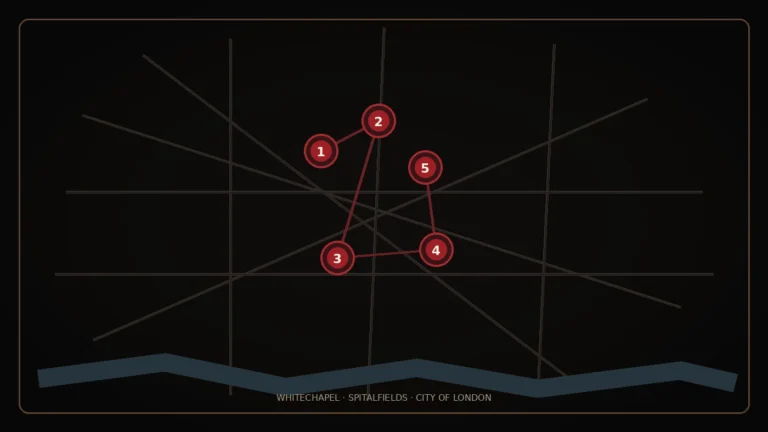
The timeline also puts the geography into perspective. These events unfolded within a compact but socially complex part of East London. Whitechapel and Spitalfields contained markets, workshops, lodging houses, religious institutions, pubs and wealthy streets within short walking distances. Read what Whitechapel was really like in 1888 for the wider setting.
Explore the chronology on the streets where it happened.
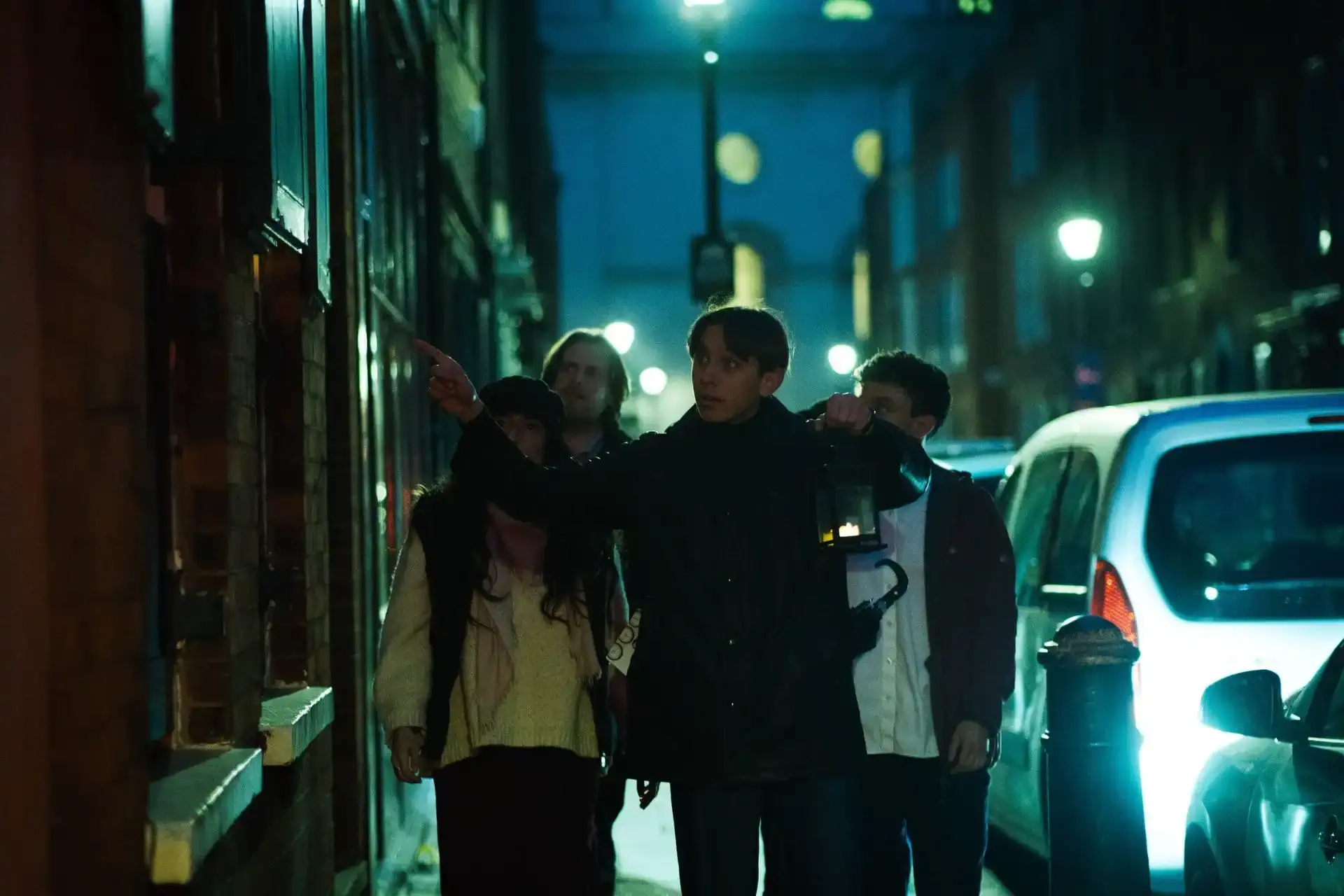
Our Jack the Ripper walking tour in London connects the surviving locations with the evidence, police investigation and lives of the women—without treating speculation as fact.
Jack the Ripper Timeline: Frequently Asked Questions
When did the Jack the Ripper murders begin?
The canonical series is generally considered to begin with the murder of Mary Ann Nichols on 31 August 1888. Earlier Whitechapel deaths, particularly those of Emma Elizabeth Smith and Martha Tabram, have sometimes been linked to the same offender, but their inclusion remains disputed.
How long did the Jack the Ripper murders last?
The five canonical murders occurred over ten weeks, from 31 August to 9 November 1888. The wider Whitechapel Murders investigation covered additional deaths and continued well beyond that period.
What was the Jack the Ripper “double event”?
The double event refers to the murders of Elizabeth Stride and Catherine Eddowes during the early hours of 30 September 1888. Their bodies were found at different locations less than an hour apart.
When was the name “Jack the Ripper” first used?
The name became public through the Dear Boss letter, dated 25 September 1888 and received by the Central News Agency two days later. There is no proof that the killer wrote it.
Who was the last canonical victim?
Mary Jane Kelly, killed on 9 November 1888 at Miller’s Court, is generally identified as the fifth and final canonical victim.